The Upper Mustang Trek is one of Nepal’s most unique and daring adventures. This 17-day journey combines rugged Himalayan landscapes with deep cultural immersion in one of the most preserved regions of the Himalayas. Known as the “Last Forbidden Kingdom,” Upper Mustang was restricted to outsiders until 1992. Even today, access requires a special permit from the Government of Nepal, ensuring its traditions and environment remain carefully protected. Often called the “Mountain Desert of Nepal,” Upper Mustang lies in the rain shadow of Annapurna and Dhaulagiri. The region is famous for its wind-carved cliffs, colorful stratified rock formations, and vast barren plateaus that resemble Tibet more than Nepal. Moreover, life here revolves around Buddhism, animal husbandry, and traditional trade, with communities that have remained almost untouched by modern influence.
Arrival in Kathmandu
Your adventure begins in Kathmandu (1,350 m), where you will be welcomed by your trekking team. This first stop allows you to prepare for the journey and, at the same time, explore UNESCO World Heritage Sites such as Pashupatinath, Swayambhunath, and Boudhanath Stupa if desired.
From Kathmandu to Pokhara
The journey continues with a scenic drive from Kathmandu to Pokhara (827 m). The 6–7 hour ride follows winding highways through terraced fields and river valleys. In addition, Pokhara serves as the gateway to the Annapurna region, where you can relax by Phewa Lake and enjoy views of Machapuchare and the Annapurna range before the trek begins.
Flight to Jomsom and Entry into Mustang
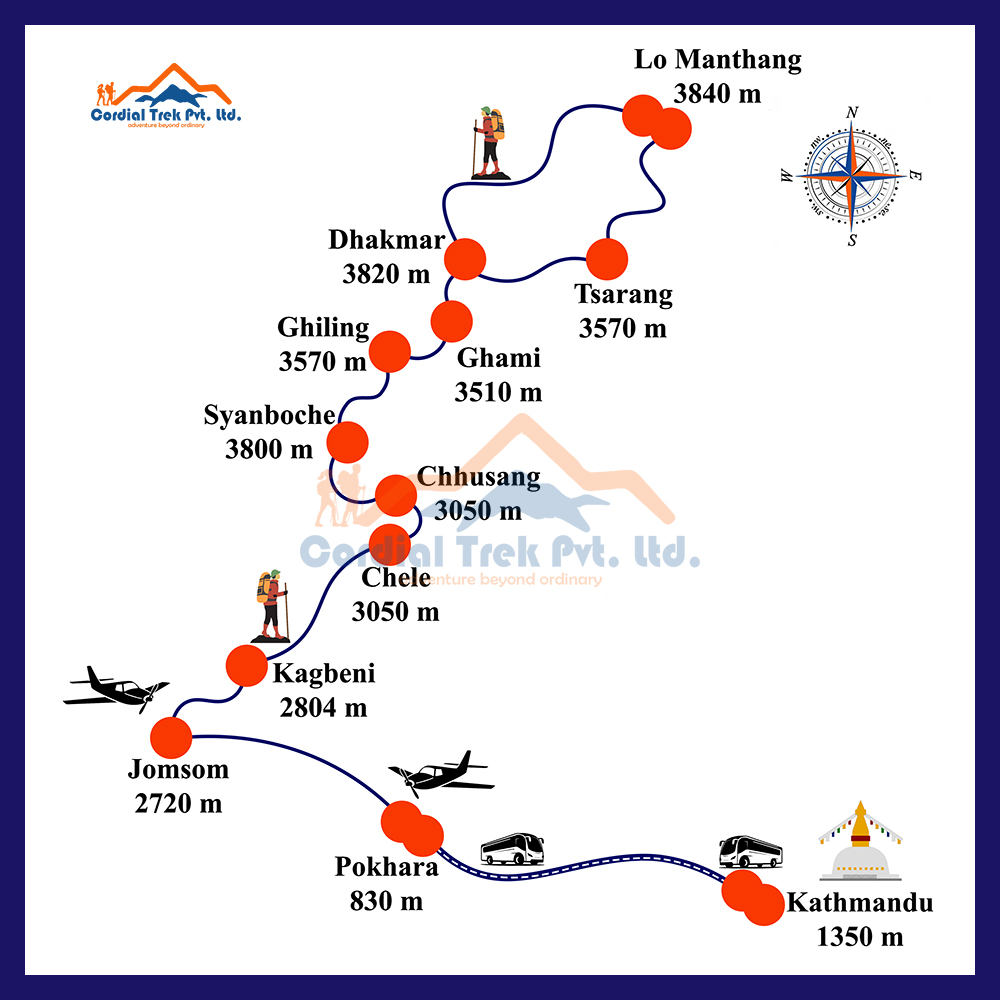
From Pokhara, a thrilling mountain flight takes you to Jomsom (2,720 m), the starting point of the trek. From here, the trail follows the Kali Gandaki River through Kagbeni, the official entry checkpoint for Upper Mustang. Consequently, this area introduces the unique arid landscapes and windswept cliffs that define the Mustang region.
Trekking Through the Mountain Desert
The trail winds through traditional villages such as Chele, Syangbochen, Ghami, and Tsarang. Along the way, you’ll pass eroded canyons, painted chortens, and long mani walls that reflect deep Tibetan Buddhist devotion. Unlike lush green Himalayan valleys, this region is a dry, high-altitude desert. As a result, every settlement feels like an oasis of culture and tradition.
Lo Manthang – The Heart of Upper Mustang
The highlight of the trek is reaching Lo Manthang (3,840 m), the ancient walled city and former capital of the Kingdom of Lo. Lo Manthang preserves a medieval atmosphere, with whitewashed houses, narrow alleyways, and centuries-old monasteries. Here, you can explore the royal palace and sacred temples. Furthermore, you’ll meet the Loba people, whose customs remain deeply tied to Tibetan Buddhism. Recently, archaeologists also discovered a series of caves near Lo Manthang. These are decorated with 13th-century Buddhist paintings and Tibetan scripts written in ink, silver, and gold. Carved high into the cliffs, the caves highlight Mustang’s role as a crossroads of culture and spirituality.
Return Journey to Jomsom
After exploring Lo Manthang and its surroundings, you may also take optional hikes to the Chhoser caves or nearby monasteries. Afterwards, the trek gradually retraces its route back toward Jomsom. Each day, however, brings fresh perspectives on the landscapes and cultural treasures of Mustang.
Back to Pokhara and Kathmandu
From Jomsom, you take a flight back to Pokhara. After a well-deserved rest at the lakeside, the journey continues with a drive back to Kathmandu. Finally, the trek concludes with a farewell dinner and a last opportunity to explore Nepal’s vibrant capital before your departure.
Best Time for the Upper Mustang Trek
The trek is unique because it is available year-round, thanks to Mustang’s location in the rain shadow of the Himalayas. Nonetheless, each season offers its own distinct features:
a. Spring (March–May): Blooming wildflowers and mild weather.
b. Summer (June–August): Ideal for Mustang, as the region remains dry.
c. Autumn (September–November): Clear skies and excellent visibility.
d. Winter (December–February): Possible snowfall, creating a more dramatic and serene landscape.
A Journey Beyond the Ordinary
The Upper Mustang Trek is more than a trek; it is a cultural and spiritual exploration. From barren mountain deserts and windswept valleys to ancient monasteries and the mystical walled city of Lo Manthang, this journey offers a rare chance to witness a way of life preserved for centuries. Therefore, for those seeking an adventure that blends Himalayan wilderness with timeless tradition, Upper Mustang remains one of Nepal’s most rewarding trekking experiences.
Upper Mustang Trek Map
Upper Mustang Trek
Additional information on Upper Mustang Trek:
Dossier disclaimer:
This trip details here are compiled with due diligence and provided in good faith. However, please be aware that information contained herein is subject to alteration and does not form a contractual agreement between the client and Cordial Trek Pvt. Ltd. The published itinerary is correct at the time of printing. We are always committed to providing you with an enriching and enjoyable trip.
Booking your Upper Mustang Trek:
We are now offering maximum flexibility for our guests’ convenience to book their trips into the Mustang region as well for 2026, 2027, and 2028. You may thus choose a date that best suits your schedule. Regarding your booking, please select one of the two available options. You may either pay USD 200 per person as a deposit amount to confirm your trip or pay the full amount of USD 1799 per person upfront. Moreover, if you opt for the deposit, the remaining is payable via Online / Card Swipe / Cash. We also accept all of the convertible currencies including USD, AUD, CAD, EURO, GBP, SGD, etc. when you arrive in Kathmandu.
Booking your International Flight:
For your 17 Days Upper Mustang Trek, you should plan to arrive in Kathmandu on Day 1 and depart on Day 17. However, having some extra one or two buffer days can prevent any issues with your return tickets.
Checklist for 17-Days Upper Mustang Trek:
Please click here for a complete checklist of your 17-Days Upper Mustang Trek. Be sure to read it carefully and pack accordingly as per your personal preferences.
Arrival information:
Once you’ve booked your flight ticket, please share the details with us so that we can provide you with a complimentary airport pickup as well. Our airport representative will then be waiting for you at the Tribhuvan International Airport in Kathmandu. They will also be holding our official name Cordial Trek and your nameplate as you exit the airport terminal. Additionally, if you’re arriving earlier, we can also arrange an accommodation for extra nights with add-on tours for additional cost.
Trek starting and ending days:
The actual trekking days are from Day 4 to Day 14. Also, Upper Mustang Trek requires a special permit to visit the region. We will therefore need your original passport after your arrival & one full day to apply for the same. Day 2 has thus been allocated as a Full Day Kathmandu Tour for the travelers while we process the necessary permits. Day 3 consists of an early morning scenic drive from Kathmandu to Pokhara. The travelers will then take a short flight from Pokhara to Jomsom on Day 4 to commence the trek.
You will then fly back to Pokhara on Day 15 and back to Kathmandu on Day 16. This way the travelers will also have plenty of time to spend in the beautiful city of Pokhara. Expect to spend 11 nights and 11 days completing the Upper Mustang Trek. You’ll begin your trek from Jomsom to Lo Manthang and Chhoser with overnight stays in Kagbeni, Chele, Syanboche, Ghami, Tsarang, Dhakmar, Ghiling and Chhusang.
Each day’s trek will begin around 07:30 AM and conclude in the late afternoon, with frequent breaks to catch your breath. You’ll have numerous photo opportunities along the way and enjoy breakfast and dinner at the same place, while lunch is en route. Additionally, your guide will provide you with regular briefings about timing and stops every morning before the trek begins.
Accommodation in Kathmandu & Pokhara:
In Kathmandu & Pokhara, you’ll stay in 3 Star Category Hotels with twin/double sharing beds.
Accommodation during the trekking days:
During the trek, your accommodation options are mostly at Teahouses. Although basic, these teahouses are clean and provide a comfortable place for a good night’s rest.
Food:
In Kathmandu, your package includes breakfast only, typically served buffet-style. Except for the day when you plan to leave for your trip early in the morning, you have an option to receive a packaged breakfast as well. During the trek, you will be provided with full board meals and may choose from a menu offering local and international cuisines.
Note: It is highly advisable to stick to vegetarian food from your arrival in Kathmandu until the end of your trek. It is because proper toilet facilities are not available everywhere along the trekking trail.
Drinking water during the trek:
Bottled water is available along the trail, but we encourage you to bring your own reusable water bottles and treat tap water to reduce single-use plastic bottle waste. Be sure to bring water treatment pills and flavorings to enhance the taste. Staying hydrated is essential, so aim to drink more than 4 liters of water every day while trekking.
Electricity, Charging and Wi-Fi:
Please keep in mind that you’re embarking on a trek and not exploring urban areas. While some facilities like charging and Wi-Fi are available at an extra cost, they are not guaranteed. We also recommend against planning to work or conduct online meetings during the trek, allowing you to fully enjoy the trekking experience.
Cash for extras and tipping:
You should have Nepali rupees for expenses such as tea, coffee, bottled drinks and Wi-Fi. Plan to carry about USD 250-300 equivalent Nepali rupees. Additionally, set aside USD 150-200 for tipping your guide and porter. The amount can vary based on the level of service provided by the field staff members.
Baggage and weight limit:
On your flight to Jomsom, the total baggage weight allowance is 15 kgs, combining both checked and carry-on baggage. Ensure you pack approximately 10/11 kilos in your checked bag and 5/4 kilos in your carry-on to stay within the 15-kilo limit. If you have items you don’t need on the trek, you can leave them at the Kathmandu hotel for storage at no cost. Remember to take a photo of your bag-tag and keep it for easy identification in case the original tag is lost.
Availability of Guide & Porter:
Every two travelers will be provided with a single porter and an experienced guide. The baggage however must be divided between 12.5 kgs each as every porter carries a maximum of 25 kgs. Additionally, both guide and porter will be insured and well equipped with necessary items and first aid kit.
Highlights of 17-Days Upper Mustang Trek:
1. Visit Lo Manthang, the capital of Upper Mustang. It is also known as the Last Forbidden Kingdom of Nepal.
2. Spectacular view of the Himalayan ranges including Mt. Annapurna I-III, Mt. Nilgiri and Mt. Dhaulagiri among others.
3. Experience the ancestral and ethnic Tibetan Buddhist culture, religion and their lifestyle.
4. Visit to Ghar Gompa, the oldest Tibetan monastery, built c. 7th century.
5. Hike via restricted areas and Trans-Himalayan regions of Nepal.
Places You’ll See :
Lomanthang is a rural municipality in Mustang district in Gandaki Province of western Nepal.
1Lomanthang
Kagbeni is a village in the Muktikshetra rural municipality of Mustang District (Upper Mustang) of the Himalayas, in Nepal.
2Kagbeni
Ghar gompa is the oldest monastery of mustang built in 8th century by guru Rinpoche “Padmasambhava” the founder of Tibetan Buddhism.
3Ghar Gompa
Pokhara is a metropolitan city in central Nepal that serves as the capital of Gandaki Province. It is the second most populous city of Nepal after Kathmandu.
4Pokhara
Kathmandu Valley consists of three districts namely Kathmandu, Lalitpur and Bhaktapur. Kathmandu is the capital city of Nepal.
5Kathmandu
Travel Itinerary:
Day 1 : Arrival in Kathmandu (Max Altitude: 1350 m / 4429 ft)
On the first day of your trip, you will be arriving in Kathmandu via Tribhuvan International Airport. A Cordial Trek representative will greet and pick you up from the airport. You will then check into a hotel and be briefed about your upcoming trek and get introduced to your guide.
Accommodation: '3 Star' Category Hotel
Meals Available: Dinner
Day 2 : Sightseeing and Trek Preparation in Kathmandu (Min Altitude: 1350 m / 4429 ft)
On the second day of your trip, you will be taken on a tour around the main highlights of Kathmandu Valley including Swayambhunath, the monkey temple, Pashupatinath, Boudhanath and Kathmandu Durbar Square. Meanwhile, a Cordial Trek representative will be applying for your special permits to Upper Mustang.
Accommodation: '3 Star' Category Hotel
Meals: Breakfast
Day 3 : Travel from Kathmandu to Pokhara (Min Altitude: 830 m / 2723 ft)
On the third day of your trip, you will be traveling to Pokhara on a 6-7 hours drive from Kathmandu. You will then check into your hotel in Pokhara and explore the city for the day. The hotel will be your halt for the night.
Optional: You might book a 30 min flight from Kathmandu to Pokhara.
Accommodation: '3 Star' Category Hotel
Meals: Breakfast
Day 4 : Fly to Jomsom and Trek to Kagbeni (Max Altitude: 2804 m / 9200 ft)
After your breakfast on the fourth day of your trip, you will be boarding an early morning flight (25 minutes) from Pokhara to Jomsom. Jomsom, the headquarters of Mustang will be the start point of your trek. It is mostly famous for its apples and strong winds.
You will then take a 2-3 hour hike towards Kagbeni, the checkpoint to the restricted region of Upper Mustang. Here you will have your lunch and go for a tour around this traditional village. A guest house in Kagbeni will be your halt for the night.
Approximate Trek Distance: 11 km / 6.8 miles
Accommodation: Mountain Guest House
Meals: Breakfast, Lunch and Dinner
Day 5 : Trek to Chele (Max Altitude: 3050 m / 10007 ft)
Your day five begins with a 5-6 hour trek from Kagbeni to Chele. On your way you will be passing through the trekking trails alongside the Kali Gandaki River to the beautiful village of Tangbe. Tangbe here offers the majestic view of Mt. Nilgiri while white-washed traditional houses, narrow alleyways, apple orchards and barley & buckwheat fields complete your foreground.
The hike then marches towards the village of Chhusang. Chhusang, is about an hour's walk north of Tangbe at the junction of river Narshing and river Kali Gandaki. It is surrounded by gigantic red, orange and silver gray cliffs spotted with cave dwellings.
The trek then forwards to the village of Chele. Chele is a small Tibetan settlement. A guest house in Chele will be your halt for the night.
Approximate Trek Distance: 15 km / 9.3 miles
Accommodation: Mountain Guest House
Meals: Breakfast, Lunch and Dinner
Day 6 : Trek to Syanboche (Max Altitude: 3800 m / 12467 ft)
Your day six begins with a 6-7 hour trek from Chele to Syanboche. The hike begins with a steep climb and descends towards the gigantic canyons that follow the buckwheat fields. The trail here combines breathtaking views of the mountain range including Mt. Tilicho (7134 m).
The journey shall then continue towards Taklam La pass (3624 m) and Dajori La pass (3735 m) while descending towards the beautiful village of Samar. The trip then passes via a forest toward Syanboche, a small settlement in the valley. A guest house in Syanboche will be your halt for the night.
Approximate Trek Distance: 11 km / 6.8 miles
Accommodation: Mountain Guest House
Meals: Breakfast, Lunch and Dinner
Day 7 : Trek to Ghami (Max Altitude: 3510 m / 11516 ft)
Day seven of your trip begins with a 5-6 hour trek from Syanboche to Ghami. The hike today ascends gently towards the Yamada La pass (3850 m) via deep valleys and wind eroded canyons with mesmerizing views of the Himalayas.
The trek then continues through barley fields towards Nyi La pass (4010 m) and to Ghami, one of the biggest villages in Upper Mustang. A guest house in Ghami will be your halt for the night.
Approximate Trek Distance: 9 km / 5.5 miles
Accommodation: Mountain Guest House
Meals: Breakfast, Lunch and Dinner
Day 8 : Trek to Tsarang (Max Altitude: 3570 m / 11713 ft)
Day eight of your trip begins with a 5-6 hour trek from Ghami to Tsarang. After your morning breakfast, the hike begins with a rough and slippery trail through the longest and ancient mani wall of Mustang towards Chortens.
The journey then continues via a suspension bridge over the Ghami river while you ascend further. The hike shall then ascend towards Tsarang La pass at 3870 m to reach the Tsarang village. The village is a desert and barren land with no sign of life that lies on the top of Charang Chu canyon with a huge fortress and red Gompa. A guest house in Tsarang will be your halt for the night.
Approximate Trek Distance: 11 km / 6.8 miles
Accommodation: Mountain Guest House
Meals: Breakfast, Lunch and Dinner
Day 9 : Trek to Lo Manthang (Max Altitude: 3840 m / 12600 ft)
Day nine of your trip begins with a 3-4 hour trek from Tsarang to Lo Manthang. The hike today marks as the shortest and easiest trek towards the Last Forbidden Kingdom of Nepal.
The day begins with a descent into the canyon while crossing the Kali Gandaki river. You will then ascend towards the Lo La pass (3950 m) for the first ever view of the beautiful village of Lo Manthang. Here, on your way towards the village, you will be able to witness the spectacular views of the Himalayas including Mt. Nilgiri, Mt. Tilicho, Mt. Annapurna I among others.
After your lunch in the afternoon, you may now choose to visit the major gompas at Lo Manthang named Jhampa, Thupchen and Chhoeda as well. A guest house in Lo Manthang will be your halt for the night.
Approximate Trek Distance: 11 km / 6.8 miles
Accommodation: Mountain Guest House
Meals: Breakfast, Lunch and Dinner
Day 10 : Round-Trip to Chhoser (Max Altitude: 3840 m / 12600 ft)
Day ten of your trip has been planned for a round trip (3-4 hours) to Chhoser, the last village of Mustang near the Tibetan border. Here you will visit the ancient and oldest Nyphu Cave monasteries, Jhong Sky Cave and other ancient monasteries in the village. A guest house in Lo Manthang will be your halt for the night.
Approximate Trek Distance: 9 km / 5.5 miles
Accommodation: Mountain Guest House
Meals: Breakfast, Lunch and Dinner
Day 11 : Trek to Dhakmar (Min Altitude: 3820 m / 12533 ft)
On day eleven, you will begin your return journey towards Dhakmar. You will today hike 6-7 hour via Marang La pass (4230 m) and Mui La pass (4100 m) towards Gyakar village.
The trail then passes towards the Ghar Gompa, the world’s oldest Tibetan monastery built c. 7th century with beautiful rock paintings. Later, a guest house in Dhakmar will be your halt for the night.
Approximate Trek Distance: 17 km / 10.6 miles
Accommodation: Mountain Guest House
Meals: Breakfast, Lunch and Dinner
Day 12 : Trek to Ghiling (Min Altitude: 3570 m / 11713 ft)
On day twelve, you will be on an early morning 5-6 hour trek to Ghiling. On your way you will be passing via the beautiful village of Ghami towards Nyi La pass (4010 m). Later, a guest house in Ghiling will be your halt for the night.
Approximate Trek Distance: 14 km / 8.7 miles
Accommodation: Mountain Guest House
Meals: Breakfast, Lunch and Dinner
Day 13 : Trek to Chhusang (Min Altitude: 3050 m / 10007 ft)
Day thirteen begins with a 5-6 hour trek to Chuusang via Syanboche. On your way, you will be passing through the village of Samar with Dajori La (3375 m) and Taklam La pass (3624 m) to reach the beautiful village of Chele.
The journey then descends down towards Chhusang, a beautiful village with an apple orchard in the wide stretch of Kali Gandaki river. A guest house in Ghiling will then be your halt for the night.
Approximate Trek Distance: 18 km / 11.2 miles
Accommodation: Mountain Guest House
Meals: Breakfast, Lunch and Dinner
Day 14 : Trek to Jomsom (Min Altitude: 2720 m / 8924 ft)
Day fourteen begins with a 6-7 hour trek to Jomsom via the village of Jharkot and Kagbeni. A guest house in Jomsom will then be your halt for the night.
Approximate Trek Distance: 17 km / 10.6 miles
Accommodation: Mountain Guest House
Meals: Breakfast, Lunch and Dinner
Day 15 : Fly to Pokhara (Min Altitude: 830 m / 2723 ft)
On day fifteen you will be boarding an early morning flight from Jomsom to Pokhara. You will then be on a sightseeing tour of Pokhara in the afternoon. Here you will be exploring the very famous Phewa Lake, World Peace Pagoda and Davis Falls among others. A hotel in Pokhara will be your halt for the night.
Accommodation: '3 Star' Category Hotel
Meals: Breakfast
Day 16 : Drive back to Kathmandu (Max Altitude: 1350 m / 4429 ft)
On day sixteen, you will be on a 6-7 hour drive from Pokhara to Kathmandu. A hotel in Kathmandu will be your halt for the night.
Optional: You may book a 30 min flight back to Kathmandu.
Accommodation: Mountain Guest House
Meals: Breakfast
Day 17 : Final Departure
On day seventeen you will be awarded with a ‘Trip Certificate’ and be bidded a final farewell. We will then drop you back to the airport three hours before your final departure.
Optional: You might also book any other new trip with us.
Meals: Breakfast
F.A.Q
How can I get my ‘On Arrival’ Nepal Visa?
Any international traveler arriving by air can get an ‘On Arrival Visa’ at ‘Tribhuvan International Airport’ in Kathmandu. ‘Overland Travelers‘ may acquire an ‘On Arrival Visa’ at the entry points of Nepal-China / Nepal-India border at following locations:
Kakarbhitta, Jhapa (Eastern Nepal) Birgunj, Parsa (Central Nepal) Kodari, Sindhupalchowk (Northern Border) Belahia, Bhairahawa (Rupandehi, Western Nepal) Jamunaha, Nepalgunj (Banke, Mid Western Nepal) Mohana, Dhangadhi (Kailali, Far Western Nepal) Gadda Chauki, Mahendranagar (Kanchanpur, Far Western Nepal)
Optional: You may also get a Visa prior to your arrival in Nepal from ‘Nepalese Diplomatic Missions‘ from your respective nations.
Note: You must carry your valid passport and two passport size photographs (35 x 45 mm / 3.5 x 4.5 cm) along with you upon your arrival in Nepal for a Visa. Travelers from Afghanistan, Cameroon, Eswatini, Ethiopia, Ghana, Iraq, Liberia, Nigeria, Palestine, Somalia, Syria and Zimbabwe however require to submit a pre-application at Nepal Consular Services in their respective nations for a Nepal Visa.
Will I be ‘Received’ upon my arrival in the Airport?
Yes, you will be received by a Cordial Trek Airport Representative with your ‘Name Sign’ on our organizational placard upon your arrival at Tribhuvan International Airport in Kathmandu.
What is the weight limit for luggage during my trekking days?
All porters available at your service (one porter for every two travelers) can carry a maximum of 25 kilograms / 55 pounds each. You are therefore allowed to load a maximum of 12.5 kilograms / 27 pounds of luggage to your porter during your trekking days.
What about the communication services available during the trekking days?
All hotels and guest houses in the city area are available with free WiFi hotspots. Also, all travelers with a valid passport and a photograph are allowed to purchase a SIM Card upon their arrival in Nepal. The traveler must however additionally purchase data / voice packages as per their need and stay in Nepal. There are 2G, 3G and 4G services available with major carriers all over Nepal. You may optionally also purchase a WiFi service in the mountains where available.
What about the meals provided during my trekking days?
You will be provided with full board meals, breakfast, or complimentary dinner as specified in your respective Trek or Tour package. However, you may choose to purchase additional meals or beverages where available. Full board meals typically include breakfast with an omelet or boiled egg, toast or local bread, and porridge served with fried potatoes. For lunch, you will be served Dal Bhat Tarkari, Nepal’s most popular dish consisting of rice, lentil soup, and vegetable or chicken curry with pickle. Alternatively, you may opt for fried noodles with eggs, chicken, or vegetables. During dinner, you can choose from Dal Bhat Tarkari, Pizza, MoMo, or Spaghetti.
How challenging is Upper Mustang Trek?
Upper Mustang Trek is a relatively challenging trek package. The package has however been successfully completed by children above 10 years of age as well as elders above 75 years of age. The difficulty however mostly relies upon your will power and physical fitness. The extremities you must expect here include a 6-7 hours hike with tea breaks in between. Additionally, Cordial Trek also provides you with an experienced trek guide capable of first aid services and other assistance.
What items should I bring—or purchase in Kathmandu/Pokhara—for this trip?
You may bring (or purchase in Kathmandu/Pokhara) the following items for this trip:
1. Warm clothing: Down jacket or puffer jacket, thermal/innerwear, hats, beanie, gloves, neck gaiter, hiking boots, warm socks, towel, and hiking pants.
2. Daypack: 20–25 liters.
3. Backpack: A duffle bag will be provided by Cordial Trek.
4. Sleeping bag: Provided by Cordial Trek.
5. Trekking poles: Provided by Cordial Trek.
6. Hydration: Camelbak or water bottle.
7. Sunscreen
8. Sunglasses
9. Headlamp: For night use.
10. Toiletries
What are the permits required for this trip?
As Upper Mustang Trek consists of restricted areas, all travelers (minimum of 2 pax) require a special permit each. However, you need not worry about the same. Cordial Trek will make necessary preparations for all the documents and travel permits (including TIMS and ACAP) required for your Upper Mustang Trek.
What's Included
3 Star Accommodation
Airport Transfers
Breakfast
Company T-shirt
Cultural Program
Domestic Flights
First Aid
Full Board Meals (Trekking Days)
Guide and Porter
Monuments Entrance Fee
Mountain Guest House
Necessary Equipment
Special Permits
Specially Abled Friendly
Tour Bus
Travel Permits
Trekking Map
Welcome Dinner
What's Excluded
Any Personal Expenses
Beverages
Gratuities for your Guide and Porter
Lunch & Dinner in Kathmandu
Lunch and Dinner in Pokhara
Nepal Visa
Travel Insurance
Activities
Cultural Program
Hiking
Sunrise
Trekking
Location Map
Why Book With Us?
Book your Trek / Trip /Tour with us for a secure, safe and joyful holiday experience.