Experience the Everest Three Passes Trek, the ultimate Himalayan challenge for 2026, 2027, and 2028. Starting with a seamless departure from Kathmandu to the world-famous Lukla airstrip, this 18-day elite journey traverses the legendary Kongma La (5,535 m), Cho La (5,420 m), and Renjo La (5,360 m). Beyond the high passes, you will explore the vibrant hub of Namche Bazaar and reach the historic Everest Base Camp. Furthermore, you will summit both Kala Patthar and Gokyo Ri for unrivaled views. This circuit provides a 360-degree immersion into Sagarmatha National Park that standard treks simply cannot match. Ultimately, our expedition package offers seasoned adventurers a professional blend of technical safety, Sherpa heritage, and unmatched views of four 8,000-meter peaks: Everest, Lhotse, Makalu, and Cho Oyu.
Everest Three Passes Trek Highlights
1. Seamless Logistics: 2026–2028 departures from Kathmandu/Ramechhap included.
2. Strategic Route: Anticlockwise direction to tackle the toughest pass with fresh legs.
3. Hidden Valleys: Authentic Sherpa culture in remote Thame and Gokyo.
4. The Icons: Everest Base Camp and 360° panoramas from Kala Patthar (5,545 m).
5. Technical Safety: Safe Cho La crossing with complimentary professional micro-spikes.
6. Optimized Health: 18-day itinerary engineered for perfect acclimatization.
7. Elite Support: Licensed guide and professional 1:2 porter ratio.
Everest Three Passes Trek: Quick Facts
1. Duration: 18 Days / 17 Nights (Kathmandu to Kathmandu)
2. Max Altitude: 5,545 m (Kala Patthar) & 5,535 m (Kongma La Pass)
3. Difficulty: Strenuous & Technical (Designed for fit, experienced trekkers)
4. Guide Policy: Mandatory Licensed Professional (In strict compliance with Nepal Government Regulations)
5. Permit Status: Sagarmatha National Park & Khumbu Municipality Permits (Seamlessly included)
Best Seasons for the Three Passes Trek
1. Spring (March–May): Blooming rhododendrons and stable weather for high-altitude pass crossings.
2. Autumn (October–November): Crisp, clear skies and peak visibility for legendary 8,000 m panoramas.
Your adventure begins with an exhilarating (approx. 20–30 minutes) flight to Lukla. This famous airstrip is known as the world’s most thrilling mountain runway. Once you land, we begin a gentle three-hour descent toward Phakding. This village serves as our first overnight stop along the turquoise Dudh Koshi River. Consequently, this scenic start provides the perfect warm-up for your body. It allows you to settle into the Himalayan rhythm while walking through lush pine forests. Furthermore, you will pass ancient carved mani stones along the trail. These beautiful details set a peaceful tone for the journey ahead.
The Ascent to Namche Bazaar
Leaving Phakding behind, the trail leads us north through the entry gate of Sagarmatha National Park at Monjo. We eventually cross the iconic, prayer-flag-draped Hillary Suspension Bridge before tackling the famous “Namche Hill.” Upon reaching Namche Bazaar (3,440 m), the vibrant Sherpa capital, you will earn your first breathtaking glimpse of Mt. Everest. To ensure your safety and comfort, we spend two nights here for perfect acclimatization before heading toward the high passes.
The High Challenge: Kongma La and Everest Base Camp
As we navigate this circuit together, we follow a deliberate anticlockwise direction. This strategy ensures you tackle the Kongma La Pass while your energy is at its peak. At 5,535 m, this pass represents the highest and most rugged point of the journey. Crossing this threshold is a significant milestone for any trekker. Building on this success, the trail leads you toward the ultimate reward of Everest Base Camp at 5,364 m. Standing in the shadows of giants, you are surrounded by the towering ridges of Nuptse, Pumori, and Everest. Witnessing the spectacular blue ice of the Khumbu Icefall fulfills a lifelong dream, providing a profound sense of achievement that stays with you forever.
Note: Our stop in Chhukung includes an acclimatization climb of Chhukung Ri at 5,550 m. This essential ascent provides the high-altitude exposure needed to cross the 5,500 m threshold safely. By gaining this elevation early, you prepare your body for the challenges of Kongma La. This approach avoids overexertion and lets you enjoy the panoramic views of Ama Dablam and Makalu.
The Ultimate Vantage: Kala Patthar Sunrise
No journey to the Everest region is complete without summiting Kala Patthar (5,545 m). Starting before dawn from the small settlement of Gorak Shep (5,164 m), you will embark on a steep 2-kilometer ascent. This challenging climb gains approximately 381 meters in elevation and typically takes 2 to 3 hours to reach the top. Although the air is thin, the reward is the most iconic 360-degree panoramic view in the Himalayas. From this rocky peak, you will watch the sunrise illuminate the faces of Everest, Lhotse, and Nuptse in brilliant golden hues.
Technical Crossing: Cho La Pass and Gokyo Lakes
The second major milestone is the dramatic Cho La Pass (5,420 m), a demanding 6 to 8-hour trek connecting the Everest and Gokyo valleys. Starting from Dzongla (4,830 m), you will embark on a steep, boulder-strewn ascent to reach the crowning glory: a technical crossing of the Nhyimagwa Glacier. To ensure your safety on this slick, blue-ice terrain, Cordial Trek provides complimentary micro-spikes for every participant. Once you conquer the summit, you will descend into the tranquil Gokyo Valley (4,750 m), home to six stunning turquoise glacial lakes. Besides, this remote sanctuary offers much needed peaceful recovery away from the busier trails of the main Everest route.
The Grand Finale: Gokyo Ri and Renjo La
Before tackling the final pass, we hike to the top of Gokyo Ri (5,357 m) for a spectacular view of the Ngozumpa Glacier, the longest in the Himalayas. Starting from Gokyo Village (4,790 m), this steep 2-kilometer ascent takes 2 to 3 hours to summit. The following day, we will cross the Renjo La Pass (5,360 m), which many experts consider the finest viewpoint in Nepal. Looking back, you will see the turquoise Gokyo Lakes framed perfectly by the Everest massif. After descending to the remote settlement of Lungden (4,380 m), the trail winds down through the Bhote Koshi Valley to the historic village of Thame. Finally, we return to Namche Bazaar, completing your epic high-altitude circuit loop.
Expert Tip: The descent toward Lungden involves steep, loose scree; therefore, we recommend extending your trekking poles to protect your knees and ensure stable footing on the rocky path.
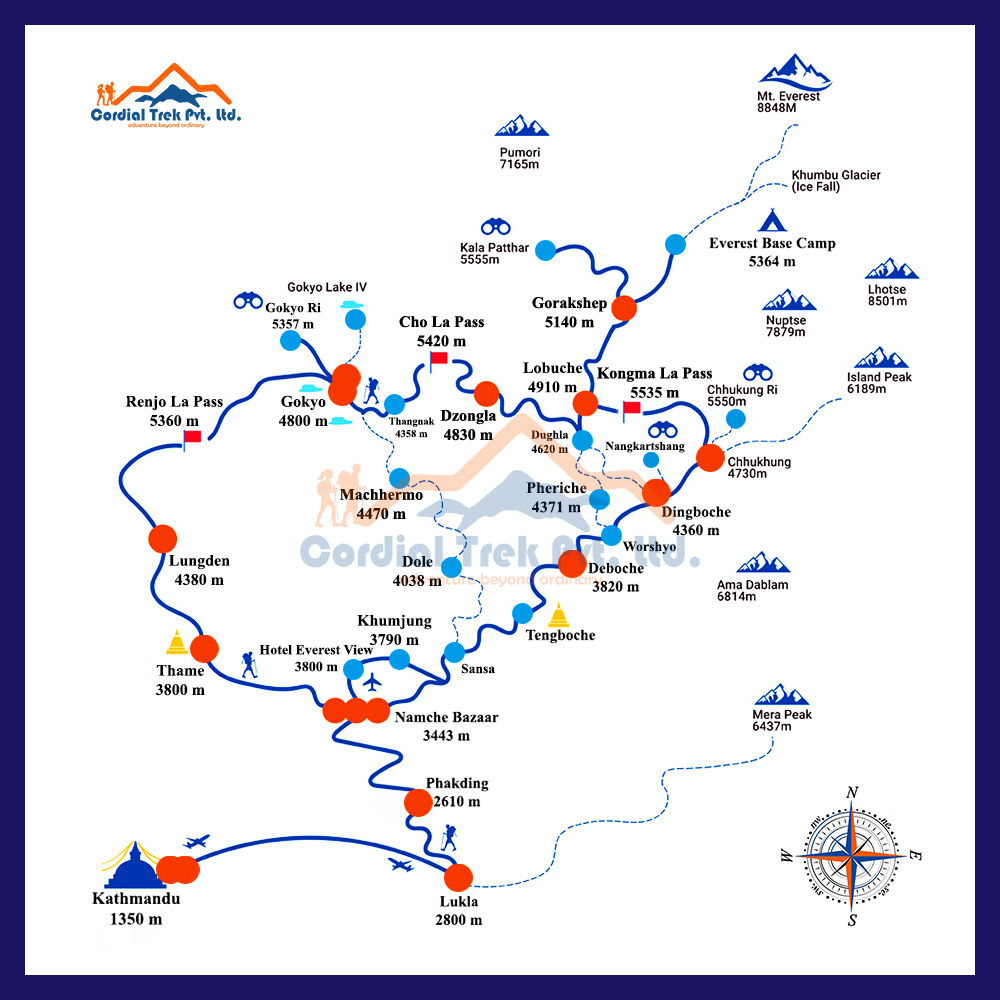
Everest Three Passes Trek Map
Everest Three Passes Trek Video Highlights
Life on the Trail
Your 18-Day Everest Three Passes Trek Timeline
The 18-Day Everest Three Passes Trek follows a precise high-altitude circuit from your arrival on Day 1 to your final departure on Day 18. Your adventure begins on Day 2 with a scenic morning flight to Lukla and a trek to Phakding. From here, the path leads you deep into the Khumbu to cross the Kongma La and reach Everest Base Camp on Day 9. You then continue through the spectacular Cho La and Renjo La passes, completing the trekking loop on Day 16. Finally, a return flight to Kathmandu on Day 17 marks the end of your mountain journey. This structured itinerary ensures a graceful, well-paced transition through the most iconic landscapes of the Himalayas.
Daily Flow and Pace
Your trekking days typically begin at 07:00 AM to take full advantage of the crisp morning weather. Every morning and evening, your leading guide provides comprehensive briefings on the terrain, elevation gains, and safety protocols. Moreover, he will maintain a steady, sustainable pace that prioritizes natural acclimatization over speed. This structured routine allows you to navigate the famous ascents of the Khumbu safely and confidently. By managing the technical rhythms of the high-altitude environment, we leave you free to immerse yourself fully in the surrounding landscape.
Your Mountain Home: Teahouse Accommodation
Throughout the trek, you will stay in hand-picked, family-run teahouses that offer a warm Sherpa welcome. Rooms are generally twin-sharing and feature comfortable beds with thick blankets. While central stoves create a cozy atmosphere in the dining areas, the bedrooms naturally remain unheated to align with high-altitude energy conservation. To keep you perfectly warm and snug, we provide high-quality sleeping bags rated to -15 °C. Choosing these authentic stays allows you to experience the true heart of Himalayan hospitality while resting comfortably for the journey ahead.
Expert Tip: For those trekking in the peak of winter or facing colder nights, we recommend wearing your down jacket and any comfortable extra layers inside your sleeping bag. Placing the provided heavy blanket on top of your sleeping bag adds a final layer of insulation, ensuring a deep and cozy sleep regardless of the mountain temperature.
High-Altitude Dining & Nutrition
To maintain your energy throughout this technical journey, your package includes full board meals with three comprehensive daily dishes. Breakfast typically features warm, energizing options like porridge, pancakes, eggs, and regular sandwiches, alongside freshly baked Tibetan bread. For lunch and dinner, you will enjoy diverse teahouse menus offering everything from the legendary Dal Bhat for reliable fuel to popular favorites like pizza, momos, fried rice, fried noodles, and spaghetti. This variety ensures you have the nutritional foundation needed to navigate the high-altitude trails of the Khumbu comfortably.
Expert Tip: To ensure optimal digestion and health at high elevations, we highly recommend prioritizing vegetarian options. Since ingredients are often transported manually to these remote altitudes, choosing fresh vegetarian dishes remains the safest and most effective choice for your well-being. This thoughtful approach to mountain nutrition ensures you stay strong and energized as you navigate the high passes.
Hydration and Beverage Guidelines
Staying consistently hydrated is the most effective way to support your body’s acclimatization throughout this 18-day expedition. We highly encourage utilizing reusable water bottles to minimize plastic waste and reduce out-of-pocket costs. To support this, your Cordial Trek lead guide manages a professional Platypus QuickDraw™ 1L Filter System for the group. This system provides instant, bacteria-free water without any chemical aftertaste. We also provide high-quality water treatment tablets as a reliable backup to ensure your supply remains safe at all times.
Expert Tip: To ensure your body handles the high-altitude environment effectively, aim to drink 3 to 4 liters of purified fluid daily. You can easily reach this goal by complementing your water intake with restorative teahouse beverages like ginger lemon honey tea or various soft drinks throughout the day.
Essential Logistics & Planning
Booking Your Everest Three Passes Trek
We offer maximum flexibility for your high-altitude adventure with departures scheduled throughout 2026, 2027, and 2028. To simplify your planning, you can secure your preferred dates with a fully transferable deposit of just USD 100. While you have the option to pay the full amount upfront, most of our travelers prefer settling their remaining balance upon arrival in Kathmandu. Notably, we accept online transfers, credit cards, or cash in all major global currencies, including USD, AUD, CAD, EUR, GBP, and SGD. As a result, our streamlined booking process ensures you can focus entirely on your physical preparation while we handle the expert logistics.
Comprehensive Travel Insurance
Navigating the high passes of the Khumbu requires not only physical preparation but also professional financial protection. To begin with, it is a mandatory requirement for all Cordial Trek participants to possess a comprehensive travel insurance policy. Notably, your coverage must specifically include “emergency helicopter evacuation” and medical expenses for trekking altitudes up to 6,000 meters. Furthermore, we strongly advise selecting a plan that covers “Trip Interruption” to protect your investment against unforeseen weather delays at Lukla. In doing so, you ensure total peace of mind, allowing you to focus entirely on the legendary vistas of the Everest region.
Expert Tip: Not all insurance policies cover high-altitude trekking. Click here to read our expert guide on How to Choose the Right Trekking Insurance for Nepal.
International Flight & Buffer Days
Regarding your international travel, we highly recommend booking your return flights with at least 2 to 3 buffer days at the end of your trip. Critically, this extra time helps align your schedule should any weather-related delays occur in the mountains. Because Lukla flights are strictly weather-dependent and often diverted to Ramechhap (Manthali) during peak seasons, having these buffer days ensures you do not miss your international connection due to unforeseen cancellations. In summary, this small planning step provides peace of mind and protects your onward travel investment.
Expert Tip: We strongly advise purchasing travel insurance that specifically covers “Trip Interruption” and “Himalayan Flight Cancellations,” as this can reimburse costs for last-minute helicopter alternatives or hotel stays if the weather closes in.
Kathmandu Hotel Logistics and Airport Transfer
From the moment you touch down at Tribhuvan International Airport (KTM), our dedicated team orchestrates every detail of your ground transportation. To begin with, a Cordial Trek representative will greet you at the terminal for a private transfer to your hotel. This personalized welcome kickstarts a seamless, door-to-door experience from your very first hour in Nepal. Moreover, your comprehensive package includes all essential hotel-airport-hotel transfers required for your domestic Lukla flight. Additionally, we arrange a timely drop-off at the international airport for your flight home. Ultimately, our meticulous logistics allow you to focus entirely on the journey ahead while we handle the complexities of the city.
Note: During the busiest trekking windows (March–May and October–November), the Civil Aviation Authority of Nepal typically utilizes Ramechhap (Manthali) Airport to ensure a more reliable flight schedule. Notably, we arrange the 4 to 5-hour ground transfer from Kathmandu to Ramechhap and the return journey at no additional cost. However, we proactively book direct flights from Kathmandu whenever they are available, even during these peak windows. Alternatively, for those seeking maximum comfort, we can arrange a direct helicopter transfer from Kathmandu for an additional cost, usually approximately USD 500 to USD 600 per person on a group-sharing basis.
Expert Tip: For Ramechhap departures, the drive begins as early as 2:00 AM. Since we manage your hotel bookings, we proactively coordinate a portable breakfast box for you to enjoy during the journey. Nonetheless, if you are on a custom trip and staying at your own accommodation, please remember to request a “packed breakfast” from your reception the night before so you stay energized for the mountain flight!
Preparation, Safety, and Personal Costs for Everest Three Passes Trek
Training and Physical Preparation
To fully enjoy the challenges of the Three Passes, we recommend a consistent fitness regimen starting 3–4 months before your departure. To begin with, focusing on cardiovascular endurance through hiking, running, or cycling will build the stamina needed for 6–8 hour trekking days. Furthermore, incorporating strength training for your legs and core helps manage the steep descents from the high passes. In doing so, you ensure your body is resilient and ready for the 5,500 m threshold.
Everest Three Passes Trek Essential Safety Guidelines
Navigating the high passes of the Khumbu requires both physical preparation and mental resilience. To begin with, please click here for our complete safety guidelines to learn how to manage acclimatization and stay secure at extreme altitudes. Furthermore, these insights cover essential strategies for maintaining your well-being throughout this challenging trek. By following these professional tips, you ensure a comfortable and unforgettable journey to the heart of the Himalayas.
Connectivity & Power on the Trail
Most teahouses along the trail offer charging stations and Wi-Fi access. However, these services are not included in the base price and require a small local fee. To begin with, please note that signal strength and power reliability often fluctuate due to the remote Himalayan terrain. Furthermore, we recommend carrying a high-capacity power bank and completing any essential connectivity tasks while in lower villages like Namche Bazaar. By preparing in advance, you ensure your devices remain powered and ready to capture the breathtaking vistas of the Three Passes.
Everest Three Passes Trek Baggage Limits & Porter Support
The weight limit for the Lukla flight is 15 kg total. This typically includes 10 kg for checked luggage and 5 kg for your carry-on. To begin, we provide a durable Cordial Trek duffle bag for your main gear. Our professional porters will carry this bag throughout the expedition. Furthermore, you will carry a personal daypack for daily essentials. Notably, we strictly recommend keeping your passport, cash, and valuables in your daypack. You should never place these items in the checked duffle. Consequently, following these limits ensures a smooth and secure journey into the heart of the Himalayas.
Everest Three Passes Trek Packing Checklist
Since this expedition involves technical terrain, meticulous preparation is key to your success. To begin with, please click here for our comprehensive packing checklist to ensure you have the specialized gear required for the Renjo La, Cho La, and Kongma La. Furthermore, we encourage you to review this list carefully to balance your personal comfort with our professional safety standards. In doing so, you ensure you are fully equipped for the diverse conditions of the high-altitude Khumbu.
Personal Expenses and Tipping Guidelines
While your comprehensive package covers all standard meals and accommodation, we recommend budgeting for personal extras to enhance your comfort on the trail. To begin with, personal expenses such as hot showers (NPR 500–1,000), device charging (NPR 300–800), and WiFi access are out-of-pocket costs that vary by altitude. Furthermore, carrying a modest amount of local currency allows you to enjoy snacks and specialty beverages at your own discretion.
Note: It is a time-honored tradition in the Himalayas to tip your professional guide and porter at the journey’s end. This gesture serves as a direct “thank you” to the dedicated team who ensures your safety and comfort through the high passes. For your 18-day trek, we recommend budgeting USD 300–400 (in local currency) for personal expenses and USD 200–300 for crew gratuities.
Everest Three Passes Trek Support & Sustainability
Professional Support Team
A highly experienced, licensed trekking guide and a professional porter are fully included to support you during the 16 active trekking days. We provide one porter for every two trekkers, with a maximum weight limit of 25 kg per porter, or 12.5 kg per person. This allows you to focus entirely on the breathtaking scenery while our experts handle the technical logistics and heavy lifting throughout the high passes.
Note: Our entire team is fully insured, well-equipped, and carries a comprehensive first aid kit for your safety. Additionally, we prioritize ethical trekking standards by strictly adhering to porter weight limits and ensuring every member of our Cordial family is prepared for the high-altitude environment.
Responsible Trekking in the Khumbu
At Cordial Trek, we are committed to preserving the fragile mountain ecosystem of Sagarmatha National Park. Notably, we strictly follow “Leave No Trace” principles and encourage our guests to use reusable water systems instead of single-use plastics. Moreover, by employing local guides and porters from the Everest region, we ensure that your journey directly supports the mountain communities you visit.
Important Everest Three Passes Trek Expedition Note
Dossier Disclaimer and Flexibility
This trip detail is compiled with due diligence and provided in good faith by the Cordial Trek team. However, please note that all information is subject to alteration due to mountain weather or safety protocols and does not form a strict contractual agreement. Notably, the published itinerary is correct at the time of publication. Because Himalayan conditions are unpredictable, we prioritize your well-being above all else. Nonetheless, we remain committed to providing an enriching and safe adventure while adapting to the dynamic mountain environment.
Places You’ll See :
Kathmandu Valley consists of three districts namely Kathmandu, Lalitpur and Bhaktapur. Kathmandu is the capital city of Nepal.
1Kathmandu
Lukla is a small town in the Khumbu Pasang Lhamu rural municipality of the Solukhumbu District in the Province No. 1 of north-eastern Nepal.
2Lukla
Namche Bazaar is a town in Khumbu Pasang Lhamu Rural Municipality in Solukhumbu District of Province No. 1 of north-eastern Nepal. Namche is the main trading center and hub for the Khumbu region.
3Namche Bazar
The base camps are rudimentary campsites at the base of Mount Everest that are used by mountain climbers during their ascent and descent.
4Everest Base Camp
Gokyo Lakes are oligotrophic lakes in Nepal's Sagarmatha National Park, located at an altitude of 4700–5000 m (15,400–16,400 ft) above sea level. Lakes and resorts are named after Gokyo Ri peak. These lakes are the world's highest freshwater lake system comprising six main lakes, of which Thonak Lake is the largest.
5Gokyo Lakes
Kala Patthar is a notable landmark located on the south ridge of Pumori in the Nepali Himalayas above Gorakshep. The ascent of Kala Patthar is very popular with trekkers in the region since it provides the most accessible closeup view of Mt. Everest.
6Kala Patthar
Travel Itinerary:
Day 1: Arrival in Kathmandu (Max Altitude: 1,350 m / 4,429 ft)
On the first day of your journey, you will arrive in Kathmandu via Tribhuvan International Airport, where a Cordial Trek representative will warmly welcome you and assist with your transfer to the hotel. After check-in, you will receive a detailed briefing about your upcoming trek and be formally introduced to your guide. Notably, this is the perfect time to perform a final gear check and discuss any specific dietary requirements for the mountains. In the evening, enjoy a traditional Nepali dinner accompanied by a cultural program, offering a delightful introduction to Nepalese hospitality and heritage.
Accommodation: 3-Star Category Hotel
Meals: Welcome Dinner
Day 2: Fly to Lukla and Trek to Phakding (Max Altitude: 2,800 m / 9,187 ft)
Your expedition begins with an early morning pickup from your hotel in Kathmandu for a private transfer to the airport. After a thrilling 30-minute flight to the Tenzing-Hillary Airport in Lukla, you will meet your support staff and receive a short briefing from your lead guide. We then begin our brisk walk towards Phakding, our halt for the night. Notably, while the trail technically descends towards the Dudh Koshi River, your body is adjusting to the significant elevation gain from Kathmandu. This initial leg is designed to ease your muscles into the trekking rhythm while you soak in the first sights of prayer wheels and mani stones.
Approximate Trek Distance: 7 km / 4.3 miles
Elevation Gain/Loss: +1,450 m / -200 m (+4,757 ft / -656 ft)
Accommodation: Mountain Guest House
Meals: Breakfast, Lunch, Dinner
Day 3: Trek from Phakding to Namche Bazaar (Max Altitude: 3,443 m / 11,296 ft)
On the third day, you will hike from Phakding to the vibrant Sherpa capital of Namche Bazaar. The journey involves crossing several high suspension bridges, including the famous Hillary Bridge, as you enter the gateway to Sagarmatha National Park. Notably, the final two hours consist of a steep, zig-zagging ascent that provides your first stunning glimpse of Mount Everest. We recommend a slow, steady pace here to manage the significant elevation gain and ensure you arrive at your guest house feeling energized.
Approximate Trek Distance: 10 km / 6.2 miles
Elevation Gain/Loss: +830 m / -187 m (+2,723 ft / -613 ft)
Accommodation: Mountain Guest House
Meals: Breakfast, Lunch, Dinner
Day 4: Acclimatization Day at Namche Bazaar (Max Altitude: 3,880 m / 12,730 ft)
This day is dedicated to proactive acclimatization to ensure your success on the three high passes ahead. You will take a 3–4 hour round-trip hike to the Hotel Everest View, which offers breathtaking panoramas of Ama Dablam, Lhotse, and Everest. Notably, "hiking high and sleeping low" is the golden rule of altitude safety; by touching 3,880 m and returning to sleep at 3,443 m, you stimulate your body to produce more red blood cells. Afterward, enjoy exploring the local bakeries and markets of this bustling mountain hub.
Approximate Trek Distance: 5 km / 3.1 miles
Accommodation: Mountain Guest House
Meals: Breakfast, Lunch, Dinner
Day 5: Trek from Namche Bazaar to Deboche (Max Altitude: 3,867 m / 12,687 ft)
The trail today leads you through rhododendron forests and high ridges toward the spiritual heart of the Khumbu, Tengboche Monastery. After exploring the monastery and observing the daily rituals of the monks, you will continue for a short descent to Deboche. Notably, staying in Deboche (3,820 m) provides a much quieter and more wind-shielded environment than the ridge at Tengboche, ensuring a more restful night’s sleep. This section of the trail is also famous for sightings of the Himalayan Tahr and colorful Danphe birds.
Approximate Trek Distance: 9 km / 5.5 miles
Elevation Gain/Loss: +420 m / -150 m (+1,378 ft / -492 ft)
Accommodation: Mountain Guest House
Meals: Breakfast, Lunch, Dinner
Day 6: Trek from Deboche to Dingboche (Max Altitude: 4,410 m / 14,468 ft)
Leaving the forest behind, you will enter the alpine zone as you trek toward Dingboche. The trail crosses the Imja Khola and passes through the village of Pangboche, home to the region's oldest monastery. Notably, the landscape becomes significantly more rugged and "moon-like" as you pass the tree line at 4,000 meters. Your guide will conduct a health check this evening, as your body begins to experience the effects of the thinner air in the shadow of the majestic Ama Dablam.
Approximate Trek Distance: 11 km / 6.8 miles
Elevation Gain/Loss: +590 m / -0 m (+1,935 ft / -0 ft)
Accommodation: Mountain Guest House
Meals: Breakfast, Lunch, Dinner
Day 7: Trek from Dingboche to Chhukung (Max Altitude: 4,730 m / 15,518 ft)
This is a shorter 3-hour ascent toward the hamlet of Chhukung, situated near the foot of Island Peak. Notably, this day is strategically designed for active rest before the first high pass. We recommend a light afternoon walk toward Chhukung Ri to further aid acclimatization and test your breathing at higher altitudes. Your guide will perform a pulse oximeter reading this evening to ensure you are physically prepared for the crossing of Kongma La tomorrow.
Approximate Trek Distance: 4.1 km / 2.5 miles
Elevation Gain/Loss: +320 m / -0 m (+1,050 ft / -0 ft)
Accommodation: Mountain Guest House
Meals: Breakfast, Lunch, Dinner
Day 8: Trek to Lobuche via Kongma La Pass (Max Altitude: 5,535 m / 18,159 ft)
Today is a significant 8–9 hour challenge as you cross the first and highest of the Three Passes. You will depart before dawn to reach the summit of Kongma La. Notably, this pass is the most rugged of the circuit; the final crossing of the Khumbu Glacier requires careful footing on the shifting moraine. We recommend carrying a full 3 liters of water and ensuring your support staff has assisted you with any heavy gear to maximize your energy for the final glacial crossing into Lobuche (4,940 m).
Approximate Trek Distance: 10.6 km / 6.6 miles
Elevation Gain/Loss: +805 m / -595 m (+2,641 ft / -1,952 ft)
Accommodation: Mountain Guest House
Meals: Breakfast, Lunch, Dinner
Day 9: Trek from Lobuche to Gorakshep and EBC (Max Altitude: 5,364 m / 17,599 ft)
Following the lateral moraine of the Khumbu Glacier, you will reach Gorakshep for a quick lunch before pushing on to Everest Base Camp. Notably, the terrain is rocky and uneven, making the high altitude feel more demanding. Standing at the foot of the world's highest peak and the Khumbu Icefall is an emotional milestone. You will return to Gorakshep (5,164 m) in the late afternoon for a well-earned rest and an early night’s sleep.
Approximate Trek Distance: 12 km / 7.4 miles
Elevation Gain/Loss: +424 m / -200 m (+1,391 ft / -656 ft)
Accommodation: Mountain Guest House
Meals: Breakfast, Lunch, Dinner
Day 10: Hike to Kala Patthar and Trek to Dzongla (Max Altitude: 5,545 m / 18,193 ft)
The morning begins with a pre-dawn climb to Kala Patthar for the most iconic sunrise view of Everest’s summit. Notably, this is the highest point of the entire trek and offers a 360-degree view of the Khumbu glacier. After descending for breakfast, you will trek toward the remote outpost of Dzongla (4,830 m). This trail offers stunning views of the turquoise Cho La Lake below. We recommend early sleep tonight to prepare for the technical glacier crossing tomorrow.
Approximate Trek Distance: 14 km / 8.6 miles
Elevation Gain/Loss: +381 m / -715 m (+1,250 ft / -2,345 ft)
Accommodation: Mountain Guest House
Meals: Breakfast, Lunch, Dinner
Day 11: Trek to Gokyo Lakes via Cho La Pass (Max Altitude: 5,420 m / 17,782 ft)
Crossing the Cho La Pass involves a rocky scramble followed by a crossing of the Cho La Glacier. Notably, Cordial Trek provides complimentary micro-spikes for this section to ensure your safety on the slick "blue ice." The descent into the Gokyo Valley (4,790 m) reveals the first of the emerald lakes, providing a peaceful and scenic end to a technical day. This is widely considered the most beautiful valley in the entire Everest region.
Approximate Trek Distance: 12.5 km / 7.7 miles
Elevation Gain/Loss: +590 m / -630 m (+1,935 ft / -2,067 ft)
Accommodation: Mountain Guest House
Meals: Breakfast, Lunch, Dinner
Day 12: Sunrise Hike to Gokyo Ri (Max Altitude: 5,357 m / 17,575 ft)
An early morning hike leads you to the summit of Gokyo Ri. Notably, this viewpoint offers a rare look at four 8,000m peaks simultaneously: Everest, Lhotse, Makalu, and Cho Oyu. The afternoon is yours to relax by the lakeside or explore the Fourth and Fifth Lakes for even more dramatic views of the Ngozumpa Glacier. This is an essential day of active rest before our final high-altitude crossing.
Approximate Trek Distance: 3 km / 1.8 miles
Accommodation: Mountain Guest House
Meals: Breakfast, Lunch, Dinner
Day 13: Trek to Lungden via Renjo La Pass (Max Altitude: 5,360 m / 17,585 ft)
Your final pass, Renjo La, provides a breathtaking "mirrored" view of the Everest range in the Gokyo Lakes. Notably, the descent into the Bhote Koshi Valley takes you off the main tourist trail and into a remote region that feels like old Nepal. We recommend keeping your camera ready for the unique perspective of the Gokyo valley from the top of the pass before reaching the quiet settlement of Lungden (4,380 m).
Approximate Trek Distance: 11 km / 6.8 miles
Elevation Gain/Loss: +570 m / -980 m (+1,870 ft / -3,215 ft)
Accommodation: Mountain Guest House
Meals: Breakfast, Lunch, Dinner
Day 14: Trek from Lungden to Thame (Min Altitude: 3,800 m / 12,467 ft)
A gentle descent through ancient salt-trading routes leads you to Thame (3,800 m). Notably, this village is the home of legendary mountaineers and houses a beautiful 16th-century monastery perched on the cliffs. The increasing oxygen levels today will significantly boost your energy and recovery as you move through this peaceful Sherpa settlement, which remains largely untouched by modern tourism.
Approximate Trek Distance: 10 km / 6.2 miles
Elevation Gain/Loss: +0 m / -580 m (+0 ft / -1,902 ft)
Accommodation: Mountain Guest House
Meals: Breakfast, Lunch, Dinner
Day 15: Trek from Thame to Namche Bazaar (Min Altitude: 3,443 m / 11,296 ft)
A pleasant 4-hour trek brings you back to the familiar comforts of Namche Bazaar (3,443 m). Notably, this "return to civilization" allows you to celebrate your achievement with a visit to a local café or a well-deserved hot shower. Enjoy your final night in the Sherpa capital, reflecting on the three massive passes you have successfully conquered over the past two weeks.
Approximate Trek Distance: 9 km / 5.5 miles
Elevation Gain/Loss: +0 m / -357 m (+0 ft / -1,171 ft)
Accommodation: Mountain Guest House
Meals: Breakfast, Lunch, Dinner
Day 16: The Final Descent back to Lukla (Min Altitude: 2,800 m / 9,187 ft)
Your last day on the trail is a long but celebratory 7–8 hour journey back to Lukla (2,800 m). Notably, upon arrival, we host a final "Farewell Dinner" with your guide and support staff. This is a respected tradition where you can celebrate your successful completion of the Three Passes and express your gratitude to the team that made this journey possible.
Approximate Trek Distance: 18 km / 11.1 miles
Elevation Gain/Loss: +200 m / -843 m (+656 ft / -2,765 ft)
Accommodation: Mountain Guest House
Meals: Breakfast, Lunch, Dinner
Day 17: Fly back to Kathmandu (Min Altitude: 1,350 m / 4,429 ft)
Bid farewell to the mountains as you board your return flight to Kathmandu. Notably, the flight offers a final aerial perspective of the peaks you have just conquered. Upon arrival, a private transfer will return you to your hotel for a well-deserved afternoon of rest or shopping in the bustling streets of Thamel.
Accommodation: 3-Star Category Hotel
Meals: Breakfast
Day 18: Final Departure
On your final day, your Cordial Trek representative will meet you at the hotel to present you with your official ‘Trip Certificate’—a testament to your incredible achievement. We will then transfer you to the airport three hours prior to your scheduled departure. We wish you a safe journey home and hope the spirit of the Himalayas stays with you forever.
Meals: Breakfast
F.A.Q
Is the Three Passes Trek suitable for beginners?
The Three Passes Trek is a magnificent journey crafted for the spirited adventurer. While it remains a demanding circuit, it is a goal well within reach for beginners who bring a high level of physical vitality and a sincere commitment to their training.
Since this path unfolds over 18 days of rugged beauty and involves considerable time spent above 5,000 m, we place a gentle emphasis on safety and endurance. To ensure you feel confident and prepared, we recommend a foundation of high-altitude experience. Completing a trek such as Annapurna Base Camp (4,130 m) or a journey of similar height is a wonderful way to harmonize your body with the mountains before embracing the challenge of the passes.
For those venturing into the Himalayas for the first time, our guides provide a thoughtful, steady pace and a dedicated focus on acclimatization. This careful approach nurtures your resilience, allowing you to move with strength and fully appreciate the breathtaking serenity of the high peaks.
Which is better: Clockwise or Anticlockwise?
At Cordial Trek, we specifically operate the circuit in an Anticlockwise direction to maximize both safety and enjoyment. This strategic approach allows you to tackle Kongma La (5,535 m)—the most rugged and demanding of the three passes—during the first week while your physical energy and mental focus are at their peak. By ascending through the Chhukung Valley, you benefit from a more gradual acclimatization profile, ensuring your body is perfectly adjusted before reaching the trek’s maximum elevation at Kala Patthar.
Moreover, this "East to West" transition provides a safer gradient and ensures that by the time you reach the breathtaking Gokyo Valley and the final Renjo La Pass, you are fully "mountain fit," allowing you to savor the spectacular views of Everest and Makalu with confidence and clarity.
How do you handle Lukla flight cancellations and the Ramechhap diversion?
To ensure the highest reliability during peak trekking seasons (March–May and October–November), most Lukla flights now operate from Ramechhap (Manthali) Airport. While this involves a 4 to 5-hour drive from Kathmandu, the shorter 20-minute flight time from Ramechhap significantly increases the chances of a successful takeoff during narrow weather windows. At Cordial Trek, we manage this transition seamlessly by providing a complimentary private transfer that departs around 2:00 AM, ensuring you are among the first in line for the morning’s earliest flights. To keep you energized, we coordinate a portable breakfast box with your hotel for the journey.
Furthermore, in the event of weather-related delays, our team acts immediately to secure the next available flight or assist with helicopter alternatives if your schedule is tight. To provide ultimate peace of mind, we strongly recommend booking 2 to 3 buffer days at the end of your journey, ensuring that even the unpredictable Himalayan weather won't interfere with your international flight home.
How do you manage Acute Mountain Sickness (AMS) and emergencies?
At Cordial Trek, your safety is the absolute cornerstone of our operations. Our licensed guides are expertly trained in high-altitude medicine and strictly adhere to our Triple-Safety Protocol to ensure a secure journey through the high passes.
Proactive Health Monitoring: Your guide conducts twice-daily health checks using a professional pulse oximeter to monitor your oxygen saturation and heart rate, allowing us to detect and manage the earliest signs of altitude adjustment.
Specialized Medical Support: In addition to a comprehensive medical kit tailored for high-altitude conditions, our team carries portable oxygen cylinders to ensure emergency support is available at every stage of the journey.
Decisive Response & Evacuation: Our guiding principle is that "descent is the best cure." Should symptoms persist, our team will coordinate an immediate descent to a lower elevation. In critical situations, we provide 24/7 support to facilitate professional helicopter evacuations to Kathmandu.
A Note on Insurance: As a remote rescue can range between USD 5,000 and 7,000, we require all participants to carry a travel insurance policy that explicitly covers helicopter rescue and medical expenses at altitudes up to 5,545 meters. This ensures that, in the rare event of an emergency, your care and transport are handled seamlessly without financial stress.
What are the specific travel insurance requirements for 2026?
For the Everest Three Passes Trek, your insurance policy must be a specialist "Adventure" or "Mountaineering" plan. Standard travel insurance typically caps coverage at 2,500 m or 3,000 m, which is insufficient for this trek where you will spend over a week above 4,000 m and reach a maximum of 5,545 m. Your policy MUST thus explicitly include:
Altitude Coverage:
Coverage for trekking up to 6,000 meters. Many insurers define "trekking" as an activity below 4,000m, so ensure your plan includes a "high-altitude" or "adventure sports" rider.
Emergency Helicopter Evacuation:
The Khumbu has no road access; therefore, helicopter rescue is the only means of emergency transport. Ensure your policy includes Search and Rescue (SAR) and, crucially, supports Direct Billing. This ensures the insurer coordinates payment directly with the helicopter operator, preventing you from having to pay USD 5,000+ out of pocket.
Trip Interruption & Delay:
We strongly advise a "Trip Interruption" clause. This covers non-refundable costs if your itinerary is disrupted by Lukla flight cancellations or if a personal emergency requires you to leave the trek early.
Do I really need micro-spikes for the Everest Three Passes Trek?
Yes. Crossing the high passes—particularly the Cho La Glacier and the shaded northern descents of Kongma La and Renjo La—often involves navigating slick "blue ice" and hard-packed snow. While full technical mountaineering crampons are rarely necessary, reliable traction is essential for stability on steep glacial inclines and frozen moraine paths.
The Cordial Trek Advantage:
To ensure your safety and confidence across all three passes, Cordial Trek provides complimentary professional micro-spikes for every participant. During our pre-trek briefing in Kathmandu, our team will personally fit these to your trekking boots and demonstrate how to secure them quickly in cold conditions. By providing this essential gear, we ensure you have the highest quality traction available while saving you the expense and luggage weight of bringing your own.
Is the water safe to drink on the trail?
Yes, when managed through our professional filtration system. To ensure your safety, we strongly advise against drinking untreated tap, well, or stream water. While natural sources may look clear, they often contain minerals or bacteria that can disrupt your journey. Cordial Trek prioritizes your health and the "Plastic-Free Khumbu" initiative by providing a professional, team-based filtration solution for every group.
Guided Hydration:
Your lead guide carries a high-performance Platypus QuickDraw™ 1L Filter System. This industry-leading technology removes 99.9999% of bacteria and 99.9% of protozoa instantly. Your guide will proactively filter water for your reusable bottles during breaks and at teahouses, meaning no chemical taste and no 30-minute wait time.
Redundant Safety:
As a backup, our guides always carry treatment tablets (Chlorine/Iodine) to guarantee a 100% safe supply under any conditions.
Teahouse Options:
You can also purchase "Boiled Water" at teahouses (NPR 200–500 per liter)—a great way to fill your bottle at night to use as a heater inside your sleeping bag.
Your Goal:
To aid acclimatization, we recommend drinking 3–4 liters of purified fluid daily. Simply bring a durable wide-mouth bottle (like a Nalgene), and we will ensure it stays topped up with clean, safe water while helping eliminate single-use plastics from the fragile Himalayan ecosystem.
Is there electricity and WiFi available?
Yes, but both are treated as "premium services" in the mountains. Most teahouses now offer high-speed internet via Everest Link. You can typically purchase a prepaid WiFi card or a 24/48-hour data package for NPR 1,500 to NPR 3,000 (approx. USD 10–25). While coverage is surprisingly good in villages like Namche, Dingboche, and Gokyo, please note that speeds can fluctuate during heavy snow or high-wind conditions.
Regarding Charging Costs:
Teahouses generally charge a fee to power your devices, ranging from USD 5 to USD 10 per full charge. As you go higher (especially above 4,000 m), these fees may increase as lodges rely entirely on solar power.
Our Recommendation:
We highly recommend carrying a high-capacity power bank (20,000 mAh+). This allows you to charge your phone and camera overnight in your room without relying on the communal charging stations, which can be crowded.
Pro-Tip: Battery Care
Keep your batteries and power bank inside your sleeping bag at night. The extreme cold at high altitudes drains battery life rapidly, and keeping them warm ensures they are ready for those legendary summit photos the next morning.
How much should I budget for personal expenses and tipping?
While your Cordial Trek package covers all meals and accommodation, you should budget for personal "mountain luxuries" and the traditional gratuity for your support team.
Daily Personal Expenses:
We recommend budgeting approximately USD 30 to USD 35 per day in local currency (Nepali Rupees). This covers out-of-pocket costs such as:
Note: There are no ATMs after Namche Bazaar that are consistently reliable; therefore, we strongly recommend withdrawing all necessary cash in Kathmandu before the trek.
Tipping (Gratitude):
Tipping is a deeply respected tradition in the Himalayas and serves as a direct "thank you" to the local experts who ensure your safety. For an 18-day circuit, we suggest a combined total of USD 250 to USD 300 per trekker for the guide and porter team.
What is the process for the Nepal 'On Arrival' Visa?
Obtaining a visa at Tribhuvan International Airport (KTM) is a straightforward three-step process. For the Everest Three Passes Trek, you must apply for a 30-day Tourist Visa (USD 50) to account for the trek duration and any potential flight delays in Lukla. The Step-by-Step Process:
Digital Form:
Upon arrival, you will fill out a digital application at one of the dedicated kiosks (or you can pre-fill this online within 15 days of arrival to save time).
Payment:
Take your application slip to the payment counter. Crucially, while credit card machines exist, they are frequently offline. We strongly recommend paying in cash with crisp, new US Dollar bills to ensure a seamless entry.
Immigration:
Present your receipt, passport (with 6 months validity), and two passport-size photos to the immigration officer for your entry stamp.
Cordial Trek Tip: Please ensure your USD bills are from the year 2013 or newer and have no tears or markings, as older or damaged currency is often rejected by the bank. By arriving prepared with exact cash, you can often clear immigration in under 20 minutes and meet our airport representative outside the terminal immediately.
What is your policy on solo travelers?
We warmly welcome solo adventurers! The Himalayas are a magnificent place for self-discovery, and Cordial Trek provides the perfect balance of community, safety, and privacy for every solo traveler.
Sign up as a solo traveler:
For those who prioritize their own space, we offer a dedicated Solo Traveler package (listed as a separate "Solo" ticket/option above). This includes a Single Supplement that guarantees a private room throughout the journey—from our boutique hotel in Kathmandu to the cozy teahouses along the trail. This ensures you have a quiet sanctuary for the deep rest essential for successful high-altitude recovery.
Join Our Community:
If you prefer a social experience, you can join one of our fixed-departure groups. This is a fantastic way to meet like-minded explorers and share the challenge of the high passes in a supportive, expert-led environment.
Expert Safety:
Regardless of your choice, you will be accompanied by a licensed, English-speaking guide who ensures your safety and handles all logistics, fully complying with the 2026 Nepal trekking regulations.
Note on High-Altitude Logistics:
While we prioritize private rooms at every stop for our solo guests, please note that in the highest settlements (such as Gorak Shep, Lobuche, or Dzongla), lodge space is physically limited. In these rare instances, if a private room is unavailable:
1. Solo Female Travelers: We ensure you are paired only with another female traveler from our group.
2. Solo Male Travelers: You will be paired with another male participant.
Note: Our guides work closely with lodge owners to ensure the most comfortable and secure arrangement possible during these short stays.
What's Included
Accommodation in Kathmandu
Airport Transfers
Breakfast in Kathmandu
Company T-shirt
Cultural Program
Domestic Flights
First Aid
Full Board Meals (Trekking Days)
Guide and Porter
Mountain Guest House
National Park Fee
Necessary Equipment
Private Vehicle
Purified Drinking Water
Travel Permits
Trekking Map
Welcome Dinner
What's Excluded
Any Personal Expenses
Beverages
Gratuities for your Guide and Porter
Lunch & Dinner in Kathmandu
Nepal Visa
Travel Insurance
Activities
Hiking
Snow and Ice
Sunrise
Trekking
Location Map
Why Book With Us?
Book your Trek / Trip /Tour with us for a secure, safe and joyful holiday experience.