Walk in the footsteps of mountaineering legends! This epic Annapurna North Base Camp (North ABC) 5-Day Trek follows the historic Maurice Herzog Trail—the raw route of the world’s first successful 8,000-meter summit. While the classic south side features massive crowds, this rugged northern expedition offers a pristine wilderness sanctuary. Choosing this trail ensures absolute solitude. Furthermore, it delivers a superior Himalayan experience by putting you face-to-face with the sheer north face of Annapurna I. Along these pure, raw trails, you will encounter thundering cascades like the spectacular, mist-heavy Phutphute Waterfall. You will also cross high, precarious suspension bridges spanning deep river gorges. As a result, this trek stands out as the ultimate high-altitude adventure for daring explorers.
Expert Expedition Note: Expect zero teahouse lodging on this isolated route. This unpolished itinerary features an exclusively fully tented camping format, engineered for trekkers seeking a genuinely high-impact wilderness challenge. Because there are no crowded tourist hubs here, this trail offers a rare opportunity to step back in time. Therefore, it challenges you to experience high-altitude exploration exactly as the pioneers did over seven decades ago.
Annapurna North Base Camp Trek – 5 Days Highlights
1. The Herzog Legacy: Trace the historic, raw 1950 route of the world’s first successful 8,000-meter mountaineering expedition.
2. Annapurna I North Face: Stand directly beneath the daunting, vertical north wall at an altitude of 4,190 meters.
3. Panchakunda Lake: Camp beside the sacred, crystal-clear glacial waters of this hidden alpine gem.
4. Pure, Raw Trails: Experience true wilderness isolation along unpolished paths completely free from commercial tourist crowds.
5. Thrilling Obstacles: Conquer high, precarious suspension bridges and witness the thundering cascades of Phutphute Waterfall.
6. Fully Tented Camping: Sleep beneath pristine starry skies in serviced, hassle-free wilderness camps managed by expert crews.
7. Tatopani Hot Springs: Revive your aching muscles by sinking into therapeutic, natural hot pools at the journey’s end.
Annapurna North Base Camp Trek – 5 Days: Quick Facts
1. Duration: 5 days / 4 nights, starting and ending in the lakeside city of Pokhara.
2. Max Altitude: 4,190 m at Annapurna North Base Camp.
3. Difficulty: Moderate to moderately challenging; requires steady physical fitness.
4. Guide Policy: Led by a government-licensed, professional English-speaking guide.
5. Permits: All mandatory ACAP conservation fees and localized trekking permits are fully managed and included.
6. Accommodation: Exclusively fully tented (private) wilderness camping managed by your support team.
7. Logistics & Departure: Features a private, high-clearance jeep transfer directly to the trailhead.
Annapurna North Base Camp Trek: Seasonal Highlights
1. Spring (March–May): Trek through exploding rhododendron forests under mild alpine weather to witness the clear mountain massifs.
3. Monsoon (June–August): Witness Phutphute Waterfall at peak flow, though heavy seasonal rains may cause minor trail hazards.
4. Winter (December–February): Experience absolute wilderness solitude during crisp mornings.
Legendary Landmarks and Highlights
The Maurice Herzog Trail
Trace the historic, raw 1950 mountaineering route used by the world’s first successful 8,000-meter expedition team. This primitive trail offers an authentic glimpse into the golden age of Himalayan exploration. Furthermore, it completely avoids the commercial crowds found on the highly developed southern routes. Trekkers will navigate untouched alpine forests and rugged river canyons while tracking the exact footsteps of legendary pioneers. Ultimately, this historic path stands out as the definitive choice for wilderness purists seeking true isolation.
Phutphute Waterfall
Witness thundering, mist-heavy cascades crashing down vertical, moss-covered wilderness cliffs along the Mistri River. Located at an altitude of approximately 3,000 meters, this spectacular geological feature acts as a pristine resting point. The roaring white water bursts directly through a natural rock opening into a vibrant turquoise basin below. Therefore, spending time at this dramatic viewpoint offers the perfect mid-trek photography break.
Panchakunda Glacial Lake
Camp along the sacred, crystal-clear emerald shores of this hidden high-alpine gem resting at 4,050 meters. The name translates to five holy ponds, which have now merged into one expansive body of water due to glacial melting. Furthermore, the lake creates a flawless mirror reflection of the giant snow-capped massifs during the crisp morning hours. As a result, waking up at this high wilderness camp delivers an unmatched visual reward.
Annapurna North Base Camp & North Face
Reach the ultimate destination of your expedition at a soaring altitude of 4,190 meters. This high-alpine sanctuary positions your tented campsite directly beneath the daunting, sheer vertical wall of rock and ice of the world’s tenth-highest peak. Colossal hanging glaciers and massive ice flutings dominate the skyline immediately above the desolate glacial bowl. Hence, establishing camp inside this silent mountain amphitheater delivers a remarkably raw and intimate mountaineering experience.
Tatopani Hot Springs
Revive your aching muscles by sinking into therapeutic, natural riverside hot pools at your journey’s end. These natural thermal waters contain rich mineral properties that instantly soothe tired joints after days of rugged trail hiking. The pools sit directly on the picturesque banks of the Kali Gandaki River, offering a tranquil environment to celebrate your trek. Furthermore, this relaxing stop provides a smooth transition back to comfort before your final transfer to Pokhara.
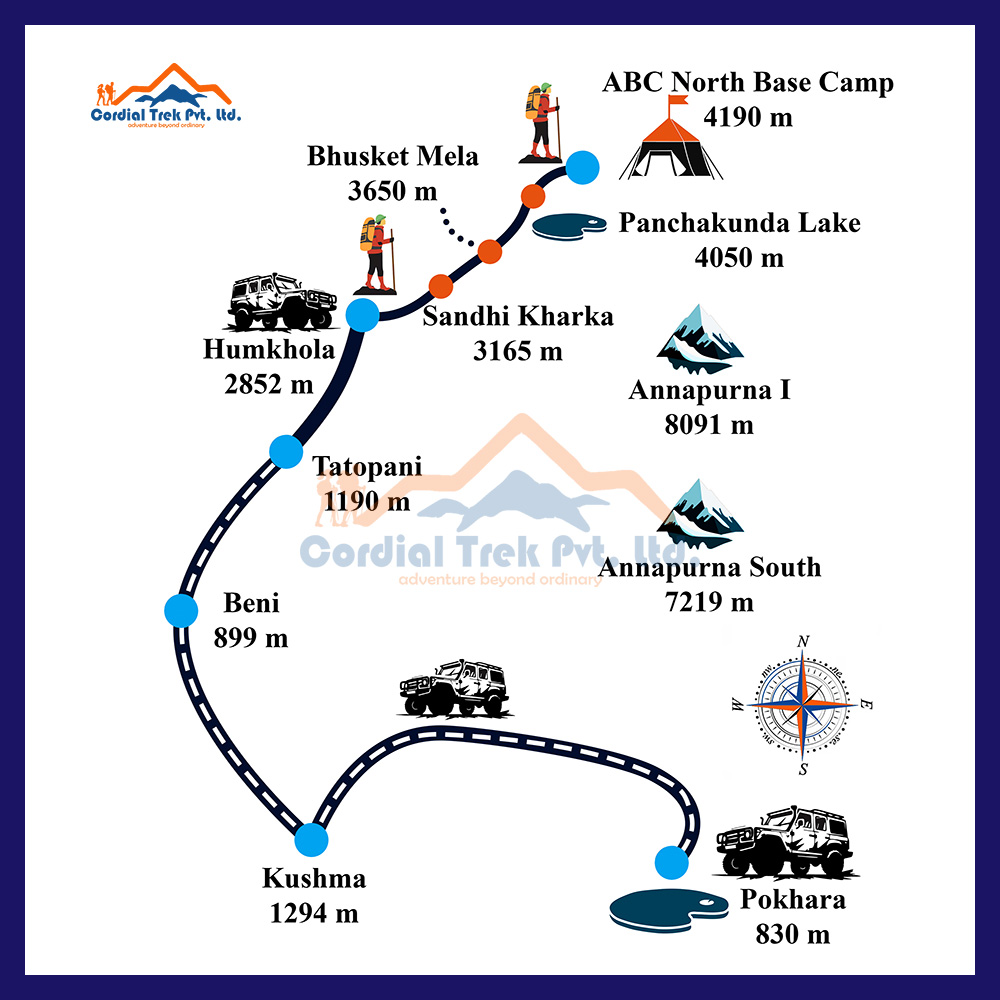
Annapurna North Base Camp Trek Map
Annapurna North Base Camp Trek Highlights
Life on the Trail
The 5-Day Expedition Timeline
This rapid, high-impact 5-Day schedule is engineered for maximum wilderness immersion. Your journey leaps forward on Day 1 with a rugged off-road drive to Hum Khola. From there, you head straight up a steep forest climb past Phutphute Waterfall to Sandhi Kharka. Next, the scenery shifts on Day 2 as you hike alongside the rushing Golden River. You will walk until you reach the wide flats of Bhusket Mela. By Day 3, you arrive at Panchakunda Lake and make your base camp push. Here, you stand face-to-face with the massive ice walls of Annapurna I. Furthermore, Days 4 and 5 take you on a fast, continuous descent back down the deep valley walls. This incredible mountain adventure ultimately concludes with a celebratory muscle soak at the Tatopani hot springs.
Daily Flow and Pace
Your trekking days start early at 07:00 AM to catch the clearest mountain weather. Because this route gains altitude aggressively, your lead guide enforces a slow, rhythmic walking pace. Furthermore, you will always arrive at a fully prepared campsite. As a result, this effortless daily flow leaves you completely free to adjust to the thinning air. Ultimately, taking these deliberate steps ensures optimal safety as you climb higher into the alpine sanctuary.
Your Mountain Home: Premium Tented Camps
Forget crowded, noisy teahouses. On this trail, you sleep in high-performance mountain tents set in remote meadows and quiet lakeside shores. We provide thick, quilted cotton mattresses and heavy blankets to guarantee your warmth. In addition, a large communal dining shed/hut acts as your main social hub. Within this space, you will enjoy hot meals, drinks and nightly safety briefings. Therefore, you get to experience true wilderness isolation without sacrificing essential base-camp comforts.
Please Note: We gladly provide a clean, complimentary sleeping bag for your journey. However, you must carry this gear yourself if you book your trek without a personal porter. Alternatively, hiring a porter allows you to walk completely light and enjoy a stress-free trek.
High-Altitude Dining and Nutrition
Keeping your energy high is the best way to enjoy every single step of your trek. Because of this, our friendly camp chef cooks up hot, comforting meals every single day. To start your morning, you will enjoy a simple, tasty breakfast of fresh eggs, local breads, and pancakes. We also serve hot tea or coffee to warm you up right away. Next, you have fantastic choices for lunch and dinner. You can opt for traditional Dal Bhat with vegetable or chicken curry. Alternatively, we serve hearty plates of fried rice, classic fried noodles, or warm, soupy noodles. Ultimately, these classic mountain favorites will keep you feeling happy, warm, and fully energized.
Hydration and Beverage Guidelines
Staying well-hydrated is the secret to feeling great in the crisp mountain air. Because of this, we always encourage our trekkers to carry reusable water bottles or hydration bladders. To support you, our guiding crew carries reliable water purification tablets with them at all times. In addition, our camp kitchen serves hot ginger and lemon teas at every meal to soothe your throat. Therefore, drinking plenty of fluids becomes an effortless and comforting part of your daily camp routine.
Essential Logistics & Planning
Booking Your Annapurna North Base Camp Trek – 5 Days
To simplify your planning, you have flexible ways to secure your trip. First, you can lock in your preferred dates with a fully transferable deposit of USD 100. Alternatively, you can pay the full amount upfront for the basic package, which excludes meals and porter services. Nonetheless, you can also choose our basic package with additional services, including your choice of meals, a dedicated porter, or both.
Please Note: You can settle your remaining balance via online transfer well before your trip begins. However, if you prefer to pay by cash or card, please plan to meet us in person in Kathmandu. We are happy to visit your hotel or welcome you to our office before your departure to Pokhara.
Flexible Booking Options and Transparent Pricing
To provide the most competitive rates, our primary package is designed as a Pokhara-to-Pokhara trip. This foundational service allows you to secure a high-quality Himalayan experience at a low base price while maintaining total control over your budget. Notably, our base price focuses on core logistics and does not include meals or porter services. However, you have the total flexibility to customize your journey by adding our Full Board Meal Plan or professional porter services as optional add-ons.
Travel Insurance and Financial Protection
Navigating high-altitude trails requires both physical preparation and professional financial protection. Even though insurance is not mandatory for the Annapurna region, we highly recommend possessing a comprehensive Nepal trekking insurance policy. Notably, your coverage should ideally include emergency helicopter evacuation and medical expenses for altitudes up to 4,190 m. Furthermore, we advise selecting a plan that covers “Trip Interruption” to protect your investment against unforeseen changes. In summary, securing a reliable policy ensures total peace of mind throughout your Himalayan journey.
Expert Tip: Not all insurance policies cover high-altitude trekking in Nepal. Please ensure your provider specifically covers activities up to 5,000 m to be fully protected. Choosing the right policy remains the safest way to protect your health and your travel investment.
International Flight and Buffer Days
Regarding your international travel, we highly recommend booking your return flights with at least 1 to 2 buffer days at the end of your trip. Critically, this extra time helps align your schedule should any weather-related delays or road closures occur in the mountains. Because Himalayan weather can be unpredictable—impacting domestic flights from Pokhara or road travel to Kathmandu—having these buffer days ensures you do not miss your international connection. In summary, this small planning step provides peace of mind and protects your onward travel investment.
Expert Tip: We strongly advise purchasing travel insurance that covers “Trip Interruption” or “Trip Delay.” Specifically, this can help reimburse costs for unexpected hotel stays or alternative transportation if the weather closes in. This is especially important for trekking in Nepal, where domestic flight schedules are highly dependent on clear mountain visibility.
Preparation and Trail Readiness
The Annapurna North Base Camp Trek is a rewarding journey perfectly suited for those with a healthy, active lifestyle. If you enjoy regular walks, light jogging, or weekend activities, you are already well-prepared for this adventure. We have seen many first-time trekkers with a good baseline of fitness complete this route comfortably and without worry. Because the trail is well-maintained and our pace is steady, your natural energy and a positive mindset are your best assets.
Expert Tip: While a strict training regime is not necessary, the secret to a more comfortable experience lies in your “trail legs.” Furthermore, in the months before you arrive, simply staying consistent with your favorite activities—like swimming, cycling, or walking—will keep your stamina high. In addition, if you want an extra boost, try a few walks on local hills or use the stairs instead of the elevator. Ultimately, these small, easy adjustments ensure you arrive feeling refreshed and ready to enjoy the 4,190 m stunning landscapes rather than focusing on the effort.
Annapurna North Base Camp Trek Safety Guidelines
Navigating the high-altitude terrain of the Annapurna Conservation Area requires proper preparation and constant awareness. Specifically, following our comprehensive Himalayan trekking safety guidelines ensures a safer, more rewarding experience while allowing you to focus entirely on the breathtaking 360-degree mountain views.
Safety Tip from Cordial Trek: Always listen to your body and maintain a steady, consistent pace rather than rushing. Proper hydration—drinking at least 3 to 4 liters of water daily—is the most effective way to help your body naturally adjust to the mountain air.
Connectivity and Power on the Trail
Pokhara serves as your final hub for reliable internet and power before entering the Annapurna region. Furthermore, we recommend completing any essential data tasks or personal calls in the city where high-speed connections are stable. However, once you begin the trek, signal strength and power reliability fluctuate due to the remote mountain terrain. In addition, local route stops feature basic structures that do not provide overnight lodging, though small tea stations offer quick hot drinks and simple packaged bites. Consequently, you will not find stable Wi-Fi or charging services along the path.
Expert Tip: For a seamless experience, we suggest carrying a small amount of Nepalese Rupees in cash to cover quick refreshments. Furthermore, because mountain power sources are non-existent outside your camp, we highly recommend carrying a high-capacity power bank. Ultimately, this ensures your camera and phone stay ready for the trek regardless of trail conditions.
Annapurna North Base Camp Trek Baggage Limits & Porter Support
For travelers trekking independently, there is no specific weight limit for your gear. However, for those who prefer to trek lighter, we offer professional porter support as an additional service. To ensure the safety and well-being of our team, each porter is limited to a maximum weight of 25 kg. We are happy to facilitate porter sharing among any number of travelers—whether a group of two or ten—provided the total weight remains within this limit.
Packing for Success: If you book a porter, we provide a durable Cordial Trek duffle bag for your main gear. Furthermore, you will carry a personal daypack for daily essentials such as water, sun protection, and extra layers. Notably, we strictly recommend keeping your passport, cash, and valuables in your daypack at all times. You should never place these items in the duffle bag. Consequently, following these professional guidelines ensures a secure and organized journey toward the North Face wilderness of the Annapurna massif.
Annapurna North Base Camp Trek Packing Checklist
Meticulous preparation is essential for a successful journey into the wilderness of the Annapurna Conservation Area. Furthermore, we recommend reviewing our complete packing checklist to ensure you carry the right gear for the region’s unique microclimates. Specifically, this guide helps you balance comfort, safety, and weight—especially important for the steady ascent to 4,190 m. In addition, it prepares you for the rapid transition from lush forest canopies to the high-alpine glacial basin. Ultimately, following this checklist ensures you are fully equipped for changing weather so you can focus entirely on the stunning 360-degree Himalayan scenery.
Personal Expenses and Tipping Guidelines
While your basic package provides the essential framework for your trek, please note that meals, drinks, and porter services are not included. Consequently, you may choose to budget for these daily costs based on your personal preferences. To begin with, if you select our Full Board option, your breakfast, lunch, and dinner are fully covered. However, if you purchase additional snacks or meals at local tea stops, daily expenses can vary. Furthermore, you might budget an additional NPR 2,000 to 3,000 per day for small snacks and bottled drinks depending on your needs. Additionally, it is a time-honored tradition to tip your professional guide as a thank you for their expertise. While entirely optional, you may plan USD 100 to 150 for your guide and USD 80 to 120 for your porter as gratitude for their service and hard work.
Optional Comforts and Essentials: Beyond food and drinks, amenities like hot showers, device charging, and Wi-Fi are unavailable along this remote route. Because you are fully supported by your local camping crew, you only need to carry a modest amount of local currency for minor roadside refreshments.
Annapurna North Base Camp Trek Support & Sustainability
Professional Support Team
A highly experienced, licensed trekking guide is fully included to provide expert navigation and safety as you head toward the Annapurna Conservation Area. Also, porter support remains available as an optional service to enhance your mountain comfort, strictly adhering to a maximum weight limit of 25 kg per porter. For your security, our team is fully insured and carries essential safety gear, including a portable oxygen can, medical pulse oximeter, emergency rescue rope, and a comprehensive first aid kit. As a result, you can enjoy a seamless mountain experience backed by the reliability of our dedicated team.
Responsible Trekking in the Annapurna Sanctuary
At Cordial Trek, we are deeply committed to preserving the fragile mountain ecosystem of the Annapurna Conservation Area. Notably, we strictly follow “Leave No Trace” principles and encourage our guests to utilize reusable water systems instead of single-use plastics to protect the local environment. Moreover, by employing local guides and staff from the Annapurna region, we ensure that your journey directly supports the mountain communities you visit. Consequently, your expedition contributes to the sustainable development and long-term preservation of these iconic Himalayan trails.
Cultural Etiquette on the Trail
1. Clockwise Rule: Pass Mani walls and prayer wheels on the left so they remain on your right.
2. Namaste Greeting: Use the traditional “Namaste” with palms together to greet local communities.
3. Photo Ethics: Always ask permission before photographing local people, children, or homes.
4. Modest Attire: Wearing modest clothing is highly appreciated when visiting villages and sacred sites.
5. Leave No Trace: Carry out all litter and avoid taking natural souvenirs like stones or flowers.
Important Annapurna North Base Camp Trek – 5 Days Note
Dossier Disclaimer and Flexibility
This trip detail is compiled with due diligence and provided in good faith by the Cordial Trek team. However, please note that all information is subject to alteration due to mountain weather or safety protocols and does not form a strict contractual agreement. Notably, the published itinerary is correct at the time of publication. Because Himalayan conditions are unpredictable, we prioritize your well-being above all else. Nonetheless, we remain committed to providing an enriching and safe adventure while adapting to the dynamic mountain environment.
Places You’ll See :
Panchakunda Lake (Pancha Kunda) is a sacred, high-altitude glacial lake situated at an elevation of 4,050 meters directly in the lap of the North Annapurna Base Camp in Myagdi.
1Panchakunda Lake
Annapurna North Base Camp (North ABC), also famously known as the Maurice Herzog Trail, sits at an altitude of 4,190 meters in the Myagdi District of Nepal.
2Annapurna North Base Camp
Phutphute Jharana (Phutphutey Waterfall) is a magnificent, hidden natural wonder located at an altitude of 3,157 meters in Narchyang, Myagdi.
3Phutphute Jharana
Sandhi Kharka (Sandhikharka) is a high-altitude alpine meadow and a crucial overnight campsite located at an elevation of 3,160 to 3,165 meters along the Annapurna North Base Camp Trek.
4Sandhi Kharka
Hum Khola (Humkhola) is a glacier-fed river and a small settlement located at an altitude of 2,852 meters.
5Hum Khola
Tatopani in Myagdi is a famous natural hot spring destination located near Beni Bazaar, the district headquarters of Myagdi.
6Tatopani in Myagdi
Travel Itinerary:
Day 1: Drive to Hum Khola & Trek to Sandhi Kharka (Max Altitude: 3,165 m / 10,383 ft)
Your adventure begins with a prompt 06:00 AM jeep pickup from your hotel in Pokhara. First, you will drive through the rugged Kali Gandaki and Mistri Khola gorges to reach the Hum Khola trailhead. After starting your trek up through the lower valley river basin, you will pass the spectacular, mist-heavy Phutphute Waterfall (Phutphute Jharna) cascading down vertical cliffs at around 3,000 meters—providing a perfect natural photo stop. Finally, a continued climb rewards you with the peaceful meadow of Sandhi Kharka for your evening camp.
Drive Distance: 115 km (6–7 hours)
Trek Distance: 5 km (3–4 hours)
Elevation Gain: +2,343 m
Accommodation: Premium Tented Camp
Meals: B/L/D available (Optional Full Board add-on)
Pro-Tip: Request a packed breakfast from your Pokhara hotel the night before.
Day 2: Trek to Bhusket Mela (Max Altitude: 3,650 m / 11,975 ft)
Start your day with a hot campsite breakfast before trekking further up the remote river valley. You will track the beautiful Sunkhola (Golden River), passing the tree line and the dramatic rock shelters of Guphaphant (Podar Cave). After winding across rugged alpine terrain and pristine glacial streams, you will reach the broad riverside flat of Bhusket Mela by early afternoon. Consequently, you will enjoy ample time to rest, acclimatize, and admire Tilicho Peak.
Trek Distance: 6 km (4–5 hours)
Elevation Gain: +485 m
Accommodation: Premium Tented Camp
Meals: B/L/D available (Optional Full Board add-on)
Day 3: Trek to Panchakunda Lake & ABC North Excursion (Max Altitude: 4,190 m / 13,746 ft)
Start your day with a hot campsite breakfast before embarking on a steady alpine ascent along massive glacial moraines and rocky ridges. As you climb, you will enjoy breathtaking views of Nilgiri and the monumental north wall of Annapurna I. First, you will reach pristine Panchakunda Lake (Narchyang Lake) in about 4 to 5 hours to rest, check in, and admire the scenery. Next, you will take a 3-hour round-trip excursion from the lake to explore the historic Annapurna North Base Camp before descending back. Tonight, you will sleep in pre-set premium tents right along the peaceful shoreline of Panchakunda Lake.
Trek Distance: 6 km (4–5 hours to lake) | 3-hour round-trip to base camp
Elevation Gain: +540 m
Accommodation: Premium Tented Camp
Meals: B/L/D available (Optional Full Board add-on)
Day 4: Trek Down to Sandhi Kharka (Max Altitude: 4,050 m / 13,287 ft)
Begin your day with a breathtaking sunrise view reflecting across Panchakunda Lake. Following morning exploration and a hot breakfast prepared by the support team, you will leave your lakeside camp by 09:00 AM. Retrace your steps down the valley, arriving at the broad riverside flat of Bhusket Mela for a well-earned lunch break. Finally, complete your gradual descent to overnight at your pre-set camp at Sandhi Kharka.
Trek Distance: 12 km (5–6 hours)
Elevation Loss: -1,025 m
Accommodation: Premium Tented Camp
Meals: B/L/D available (Optional Full Board add-on)
Day 5: Trek to Hum Khola & Drive Back to Pokhara (Max Altitude: 3,165 m / 10,383 ft)
Enjoy a final trail breakfast at Sandhi Kharka before a crisp morning hike down to the river basin. Your private jeep awaits at the Hum Khola trailhead. Leaving the wilderness behind, you will drive down the valley to Tatopani for lunch. Here, you can enjoy an optional soak in the natural hot springs to soothe your muscles before completing your scenic journey back to your hotel in Pokhara.
Trek Distance: 5 km (2–3 hours)
Drive Distance: 115 km (6–7 hours)
Elevation Loss: -2,343 m
Meals: B/L available (Optional Full Board add-on)
F.A.Q
Is the Annapurna North Base Camp Trek suitable for beginners?
Precisely, the Annapurna North Base Camp Trek is best suited for trekkers with a good level of fitness and a sense of adventure. While many first-time hikers have successfully enjoyed the journey, prior multi-day trekking experience remains highly recommended. Unlike the more developed southern route, the historic Herzog Trail follows rugged mountain terrain with zero permanent teahouse lodging infrastructure; however, fully serviced tented camps are pre-set and available year-round.
Please Note: Trekkers should still be prepared for steep scree slopes, rocky moraines, significant elevation gains, and wilderness camping. Nonetheless, with proper preparation, strong physical endurance, and the support of an experienced guide, this remarkable expedition provides an incredibly rewarding Himalayan adventure. If you are stepping onto the trail for the very first time, take things at a steady pace, embrace the challenge, and get ready for the trip of a lifetime!
What happens if I cannot keep up with the group’s trekking pace?
Your safety and comfort are our absolute priorities, and we ensure that no one is ever left behind. Our team is highly experienced in managing group dynamics based on your specific booking:
a. For groups with porters: If you prefer a more relaxed pace, you will be accompanied by our government-licensed porter-guides, who are fully qualified to lead and support you while the lead guide supervises the forward group.
b. For groups without porters: Your lead guide will manage the group's pace to ensure everyone stays within a safe and visual distance. If someone is significantly behind, the guide will prioritize the slower trekker’s safety and adjust the day's pacing accordingly rather than pushing past safe boundaries.
How do you manage Acute Mountain Sickness (AMS) and emergencies?
At Cordial Trek, your safety is the absolute cornerstone of our operations. Our licensed guides are expertly trained in high-altitude medicine and strictly adhere to our Triple-Safety Protocol:
a. Proactive Health Monitoring: Your guide conducts twice-daily health checks using a professional pulse oximeter to monitor your oxygen saturation and heart rate.
b. Specialized Medical Support: Our team carries comprehensive medical kits and portable oxygen canisters to ensure emergency support is available at every stage.
c. Decisive Response & Evacuation: Our guiding principle is that "descent is the best cure." Should symptoms persist, we coordinate an immediate descent. In critical situations, we provide 24/7 support to facilitate professional helicopter evacuations to Pokhara.
What are the specific travel insurance requirements for this trek?
For the Annapurna North Base Camp Trek, your insurance policy must be a specialist "Adventure" or "Mountaineering" plan. Standard travel insurance typically caps coverage at 2,500 m, which is insufficient for this trek. Your policy MUST explicitly include:
a. Altitude Coverage: Ensure your policy covers trekking up to 5,000 meters.
b. Emergency Helicopter Evacuation: Ensure your policy includes Search and Rescue (SAR) and supports Direct Billing. This prevents you from having to pay USD 3,000–3,500+ out of pocket in an emergency.
c. Trip Interruption: We strongly advise a clause to cover non-refundable costs if your itinerary is disrupted by mountain conditions or personal emergencies.
Is the water safe to drink on the trail?
Yes, when managed through our professional purification standards. To ensure your safety, we strongly advise against drinking untreated tap or stream water. Cordial Trek prioritizes your health and environmental conservation through:
a. Purification Tablets: Our guides use medically approved tablets to eliminate 99.9% of harmful bacteria and viruses. This ensures your water is safe and purified for reusable bottles throughout the trek.
b. Camp Kitchen Standards: Our support staff prepares safe drinking and cooking water at every camp stop.
c. Sustainability: We recommend bringing a quality Thermos or insulated bottle to help us eliminate single-use plastics from the fragile Annapurna ecosystem.
Is there electricity and WiFi available?
No, remote wilderness areas along this route do not feature commercial electricity grids or stable internet connections. Because this trail is entirely uncommercialized, teahouses do not offer lodging, Wi-Fi, or device charging stations.
a. Reliable Backup: We strongly recommend carrying a high-capacity power bank (20,000 mAh+).
Pro-Tip: The extreme cold drains batteries rapidly. Keep your phone and power bank inside your sleeping bag at night to keep them warm and ready for sunrise photos.
How much should I budget for personal expenses and tipping?
Your daily budget depends primarily on your meal plan choice. We recommend withdrawing all necessary cash in Kathmandu or Pokhara, as there are no ATMs on the trail.
a. Without a meal plan: Budget USD 40–45 (NPR 6,000–7,000) per day for full board meals.
b. With a meal plan: Budget USD 15–20 (NPR 2,000–3,000) per day for minor snacks and miscellaneous items.
c. Tipping (Gratitude): Tipping is a respected tradition. For this trek, we suggest a combined total of USD 150–200 per trekker for the guide and porter team, usually presented on the final evening.
What is your policy on solo travelers?
Cordial Trek warmly welcomes solo adventurers! Kindly find our perfect balance of community, safety, and privacy through:
a. Solo Packages: We offer a dedicated Solo Traveler option with a single supplement that guarantees a private guide, porter, and a private room in tent camp.
b. Join a Group: You can join one of our fixed-departure groups to meet like-minded explorers in a supportive environment.
Note on High Altitude: At the highest points—specifically Panchakunda Lake and Annapurna North Base Camp—tent space is physically limited. In rare instances where a private tent is unavailable, we ensure you are paired only with a traveler of the same gender from our group.
Is there secure luggage storage available during the trek?
Yes. We provide complimentary secure storage at our Pokhara facility for your primary luggage throughout the duration of your trek. Your non-trekking belongings are monitored and protected until your return, allowing you to trek with a lighter load and total peace of mind.
How are the guides' and porters' meals and lodging managed?
We believe in ethical trekking and the absolute well-being of our field team. While a licensed guide is always included as a core part of your package, porters are an optional service you can add. In either case, the service fees are fully inclusive of their lodging, meals, insurance, and professional high-altitude equipment. There are no additional costs to you for their welfare; Cordial Trek manages these responsibilities entirely to ensure our team is well-cared for, fairly compensated, and motivated to provide you with the best experience possible.
What's Included
Company T-shirt
First Aid
Necessary Equipment
Pick Up and Drop
Private Jeep
Seasonal Fruits
Tented Camp
Travel Permits
Trekking Guide
Trekking Map
What's Excluded
A Porter (Extra Service)
Any Personal Expenses
Beverages
Full Board Meals (Extra Service)
Gratuities for your Guide
Travel Insurance
Activities
Camping
Hiking
Snow and Ice
Sunrise
Sunset
Trekking
Location Map
Why Book With Us?
Book your Trek / Trip / Tour with us for a secure, safe and joyful holiday experience.